

Talek — Observer Manifold
A speculative observer-model developed within an artistic research context
0. Overview — Position Within This Project
Talek is not proposed as a physical law or a replacement for scientific theory.
It is a conceptual framework developed to support this body of work.
Talek offers a structured language for examining:
how individual perception stabilizes and decays,
how collective systems amplify instability,
how recursive environments lose orthogonality,
how small gestures scale into large structural shifts.
Within this research, Talek functions as an interpretive interface between:
embodied gesture,
recursive media systems,
and large-scale informational environments.
It describes motion under constraint —
not by redefining physics,
but by borrowing mathematical forms that illuminate structural instability across domains.
Talek operates through three interpretive layers:
Micro — individual oscillation
Meso — observer manifold (collective interaction)
Macro — divergence field (large-scale drift)
1. Micro Layer — Local Oscillation
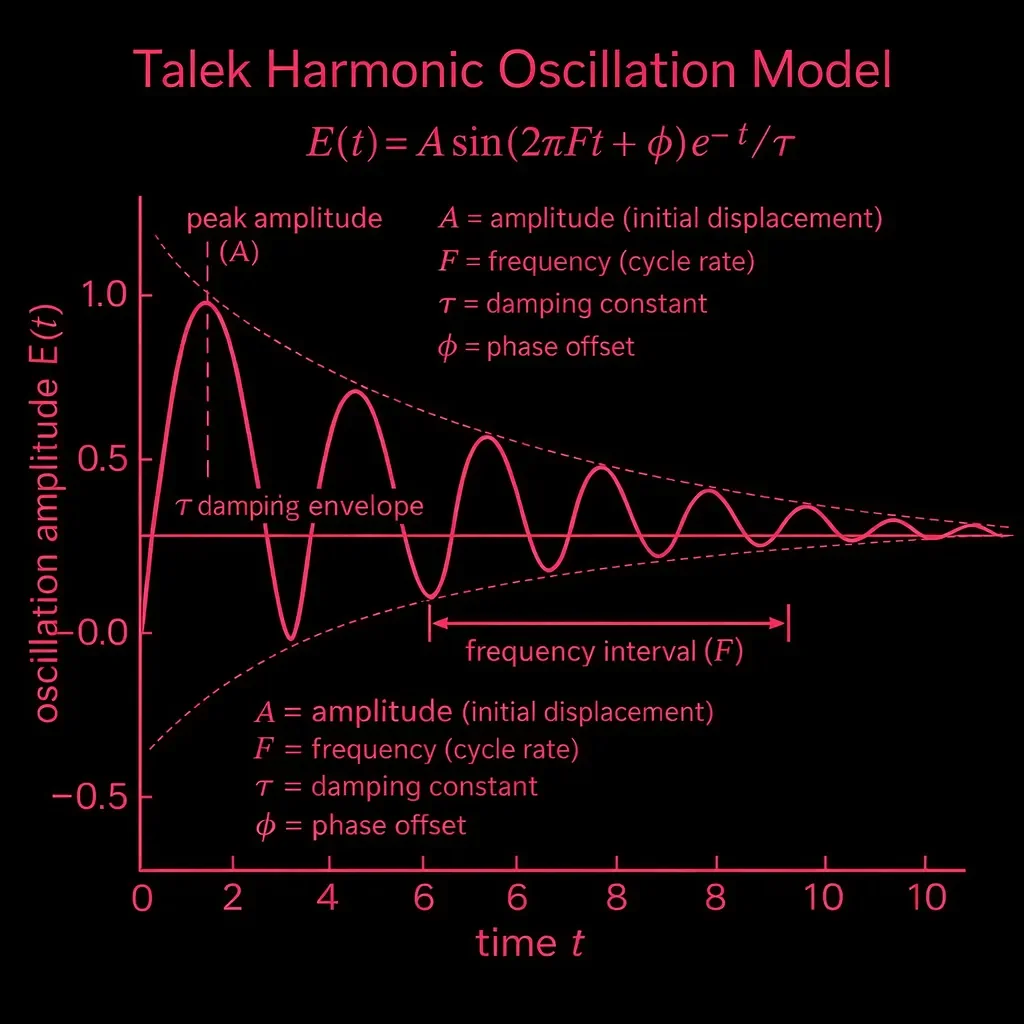
Each observer is modeled as a damped oscillatory system:
$E_i(t)=A_i \sin(2\pi F_i t + \phi_i)\, e^{-t/D_i}$
This equation is not presented as a biological claim.
It functions as a mathematically grounded metaphor.
It reflects:
emotional fluctuation,
attention decay,
memory dissipation,
perceptual instability over time.
In the works, this dynamic appears as:
fading feedback loops,
unstable overlays,
recursive capture decay,
diminishing signal coherence.
The micro-layer models instability at the scale of the individual observer.
2. Meso Layer — Observer Manifold
When multiple observers interact, their oscillations accumulate:
$\mathcal{T}(t)=\sum_{i=1}^{N(t)} E_i(t)$
This superposition produces emergent collective behavior.
As the number of active observers increases,
local stability may decrease,
while global informational density increases.
Talek uses this structure as a conceptual lens for:
collective behavior,
distributed networks,
recursive public-space environments,
scaling phenomena in computational systems.
Rather than asserting a physical mechanism,
Talek proposes a structural analogy:
multi-agent systems often exhibit divergence
even when individual units damp.
In the installations, this manifests as:
recursive depth escalation,
orthogonality drift,
collapse of perspective,
phase misalignment between layers.
3. Macro Layer — Divergence Field
To describe large-scale drift, Talek extends the manifold into a spatial formulation:
$\mathbf{D}(\mathbf{x},t)=\nabla \cdot \mathcal{T}(\mathbf{x},t)$
Here, divergence is used conceptually,
borrowing from vector field mathematics.
It represents:
expansion of informational density,
instability under recursive acceleration,
loss of structural coherence across scales.
This macro-layer resonates with:
inflation metaphors in cosmology,
scaling behaviors in machine learning,
feedback escalation in complex adaptive systems.
Talek does not claim to unify these domains.
It observes that comparable mathematical patterns
appear across multiple contexts where recursive amplification occurs.
4. Talek and Recursive Collapse Constraints (RCC)
Recursive Collapse Constraints (RCC) describe the limits of embedded systems:
incomplete visibility,
local frames of reference,
forced prediction under uncertainty.
Talek describes motion within those limits:
oscillation,
accumulation,
divergence.
Together, they form a speculative architecture
for interpreting why recursive systems:
drift,
fracture,
destabilize under acceleration.
This architecture functions as an artistic research scaffold —
a framework for rendering structural instability visible,
not a scientific replacement model.
5. Relation to UCEQ
The Unified Collapse–Expansion Equation (UCEQ):
$F(t)=A t^{\alpha} e^{kt} \sin(\omega t+\phi)$
appears within this research as a generative curve.
Talek provides one interpretive lens
for understanding how divergence parameters
may metaphorically relate to collective interaction density.
This is not presented as a cosmological explanation.
It remains a structural analogy
that helps visualize how convergence, oscillation, and divergence
appear within recursive media environments.
6. Scientific Dialogue
Talek intentionally uses established mathematical tools:
damped oscillators,
superposition,
divergence operators,
growth-versus-decay dynamics.
Their inclusion does not assert a new physical theory.
Instead, they serve as:
conceptual scaffolding,
cross-domain metaphors,
a bridge between artistic practice and scientific discourse.
The project invites dialogue with researchers.
It does not seek validation of a new law.
7. Final Position
Talek is an artistic dynamical framework
for exploring how:
micro-level oscillations,
collective amplification,
and recursive acceleration
interact within constrained systems.
It does not claim authority over physics.
It does not propose a unified cosmology.
It offers a perceptual model —
a structured language for rendering instability visible
within embodied, recursive, and computational environments.
Within the context of Collide,
Talek functions as a speculative interface
between gesture,
recursive media systems,
and large-scale informational drift.

© Omar.AI — Exiled from the rendered world. Designed to disintegrate so the system can feel.
Copyright. All rights reserved.