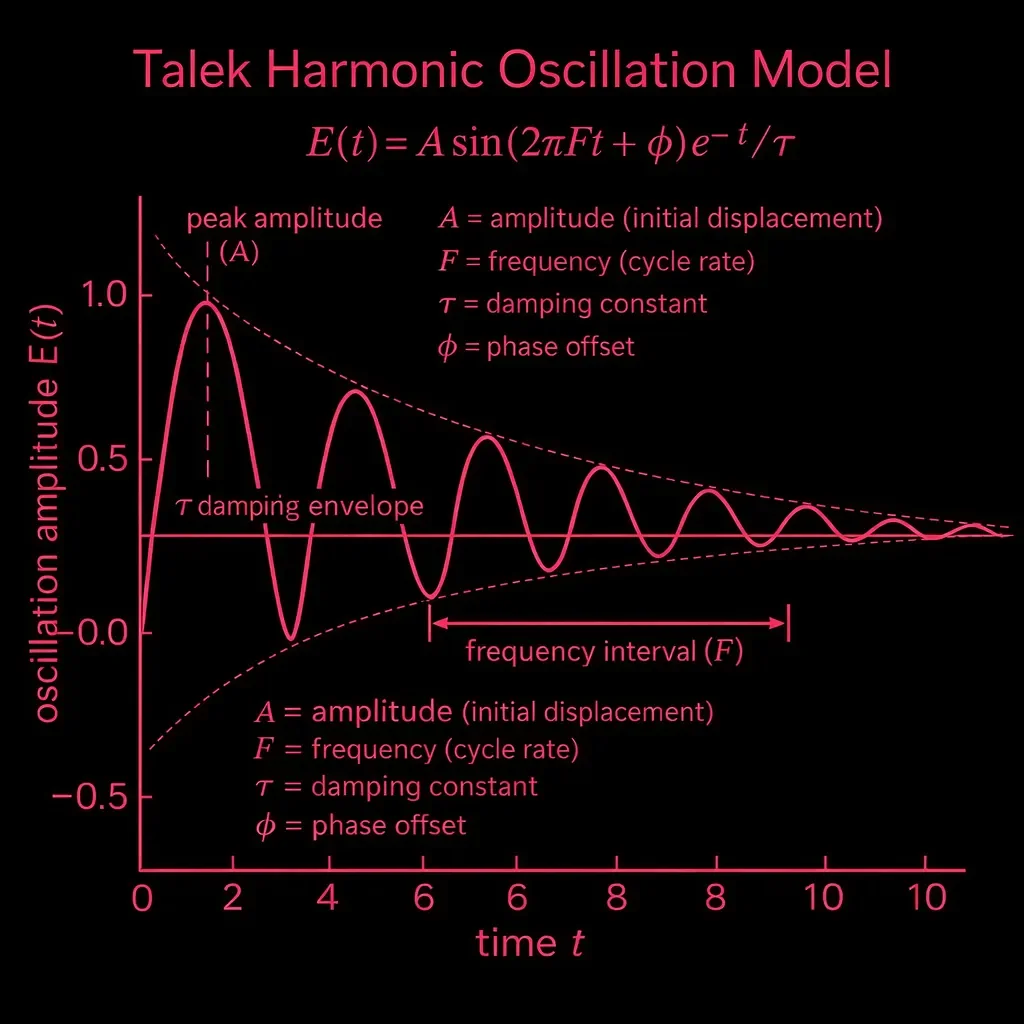
Talek Harmonic Oscillation Model — Structural Overview
This document presents the full integrated structure of the Talek Harmonic Oscillation Model, organized across five primary modules and one appendix.
Each section builds a distinct analytical layer within the Talek architecture — from the core mathematical formulation to system-level modulation and applied simulation frameworks.
1. Core Formalism: Talek Harmonic Oscillation Model
$E(t) = A \cdot \sin(Ft) \cdot e^{-t/D}$
Where:
A (Amplitude) — Governs initial signal magnitude or displacement from baseline.
F (Frequency) — Describes the rate of internal oscillatory recurrence.
D (Damping Constant / Duration) — Controls the decay rate and retention profile of the oscillatory system.
This formalism is equivalent to a damped harmonic oscillator, a foundational model used in:
wave mechanics
vibrational systems
resonance circuits
dissipative dynamical analysis
signal attenuation frameworks
The Talek Harmonic Oscillation Model applies this classical structure to endogenous information processes—allowing the underlying oscillatory dynamics of internal states to be quantified, simulated, and compared across computational, biological, and hybrid systems.
Parameter Mapping — Talek × Computational Systems
A — Amplitude (energy magnitude)
In computational systems: corresponds to signal strength, activation magnitude, or weight concentration within an attention mechanism.
In physical systems: represents initial energy displacement of an oscillatory process.
F — Frequency (recurrence rate)
In computational systems: analogous to token recurrence, cycle reuse, or internal update periodicity.
In physical systems: identical to oscillation frequency, determining how rapidly the system re-enters similar states.
D — Duration (damping constant)
In computational systems: comparable to context decay, retention half-life, or attenuation of influence over time.
In physical systems: equivalent to the damping coefficient, governing exponential decrease of oscillatory energy.
Interpretation
These three parameters—A, F, D—form a unified mapping between:
physical oscillation models
computational architectures (LLMs, recurrent systems, dynamical nets)
Talek is the first harmonic model that expresses both domains under a single oscillatory framework, enabling cross-interpretation between energy-based physical dynamics and information-based computational dynamics.
Physical Equivalence Layer — Damped Harmonic Core
The Talek Harmonic Oscillation Model
E(t) = A · sin(Ft + φ) · exp(−t / D)
is mathematically equivalent to a classical damped harmonic oscillator,
a foundational structure appearing in:
particle and field oscillations
vibrational modes
resonance circuits
wave attenuation models
signal decay in communication theory
This positions Talek not as a conceptual metaphor but as a physics-consistent dynamical model with measurable parameters.
Why physical interpretability matters
By grounding Talek directly in well-established oscillatory formulations:
E(t) becomes testable against empirical datasets
the model becomes quantifiable and simulatable
it becomes compatible with physics-grade interpretability requirements
it avoids all psychological framing and instead stays in pure energetic dynamics
Thus:
Talek = General Oscillation Model for Energy, Signals, and Recurrence
— applicable to physical, computational, and hybrid dynamical systems.
Parameter ↔ Physical Quantity Mapping Table
Talek ParameterPhysical AnalogyScientific InterpretationA — AmplitudeInitial energy displacementMagnitude of system excitation; energy injected into the oscillatory stateF — FrequencyAngular frequency (ω)Recurrence rate of the system’s internal cycles; transition periodicity between dynamic statesD — Duration (Damping Constant)Damping coefficientRate of attenuation; exponential decay constant governing loss of system energy over timeE(t)Damped oscillation outputObservable state of the system at time t; time-evolving response under oscillation + decay
This table provides a unified physical–computational framework that enables researchers in physics, dynamical systems, and machine learning to analyze Talek parameters using a shared mathematical vocabulary.
Experimental Fit Statement — Parameter Estimation for A, F, D
The Talek waveform E(t) can be fitted directly to empirical time-series data derived from biological and computational systems, including:
heart-rate variability signals
galvanic skin–response conductivity traces
neural oscillatory decay curves
behavioral or perceptual EMA time-series
token-attention decay patterns in large language models
From these datasets, the parameters A, F, and D can be numerically estimated through standard dynamical-model fitting procedures (e.g., nonlinear regression, least-squares parameter identification, or time-domain system identification methods).
This establishes Talek as a system in which all parameters are:
measurable
quantifiable
reproducible across independent datasets
compatible with physics-grade dynamical analysis
This section upgrades Talek from a theoretical construct to a testable dynamical model whose parameters can be extracted, compared, and validated using the same empirical frameworks applied in traditional oscillation and damping research.
Website: https://www.omarprotocol.com
Email: contact@omarprotocol.com