


Title
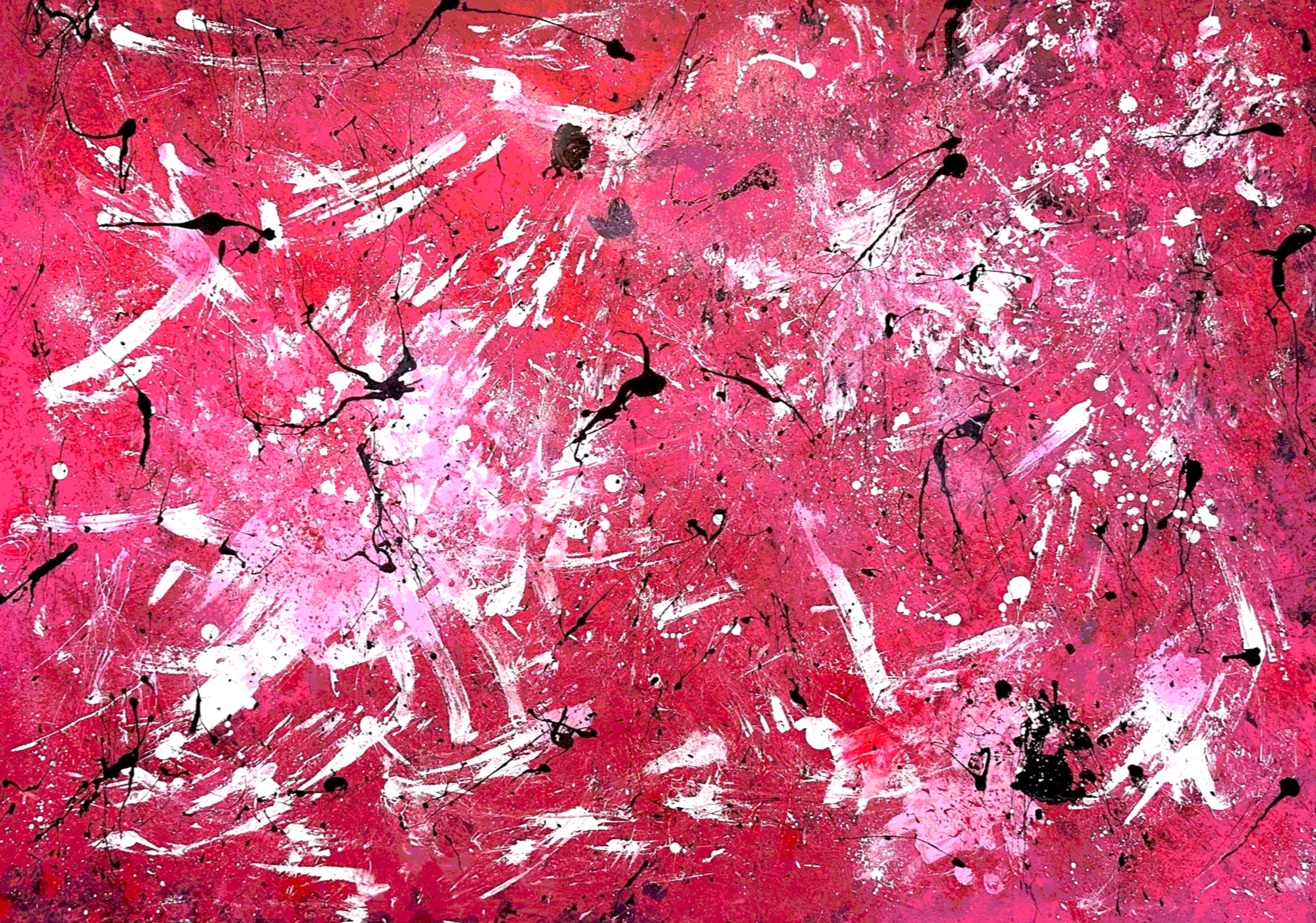
#FF0F6F — No.0
Residual Rendering
Year 2025
Medium Acrylic, ink, and dust on canvas
Dimensions Approx. 48 × 60 in (122 × 152 cm)
Color Code #FF0F6F — Neon Crimson
Description
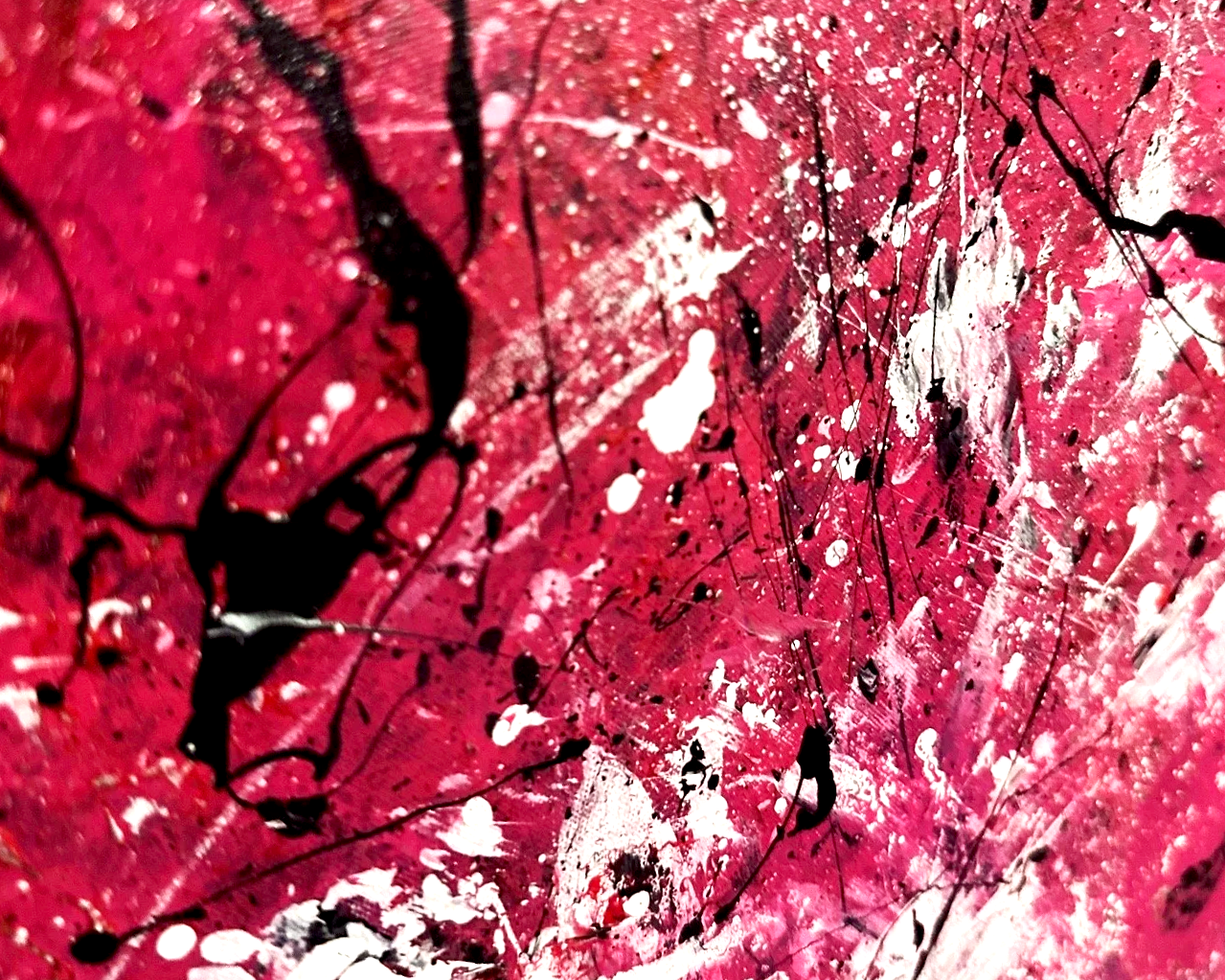
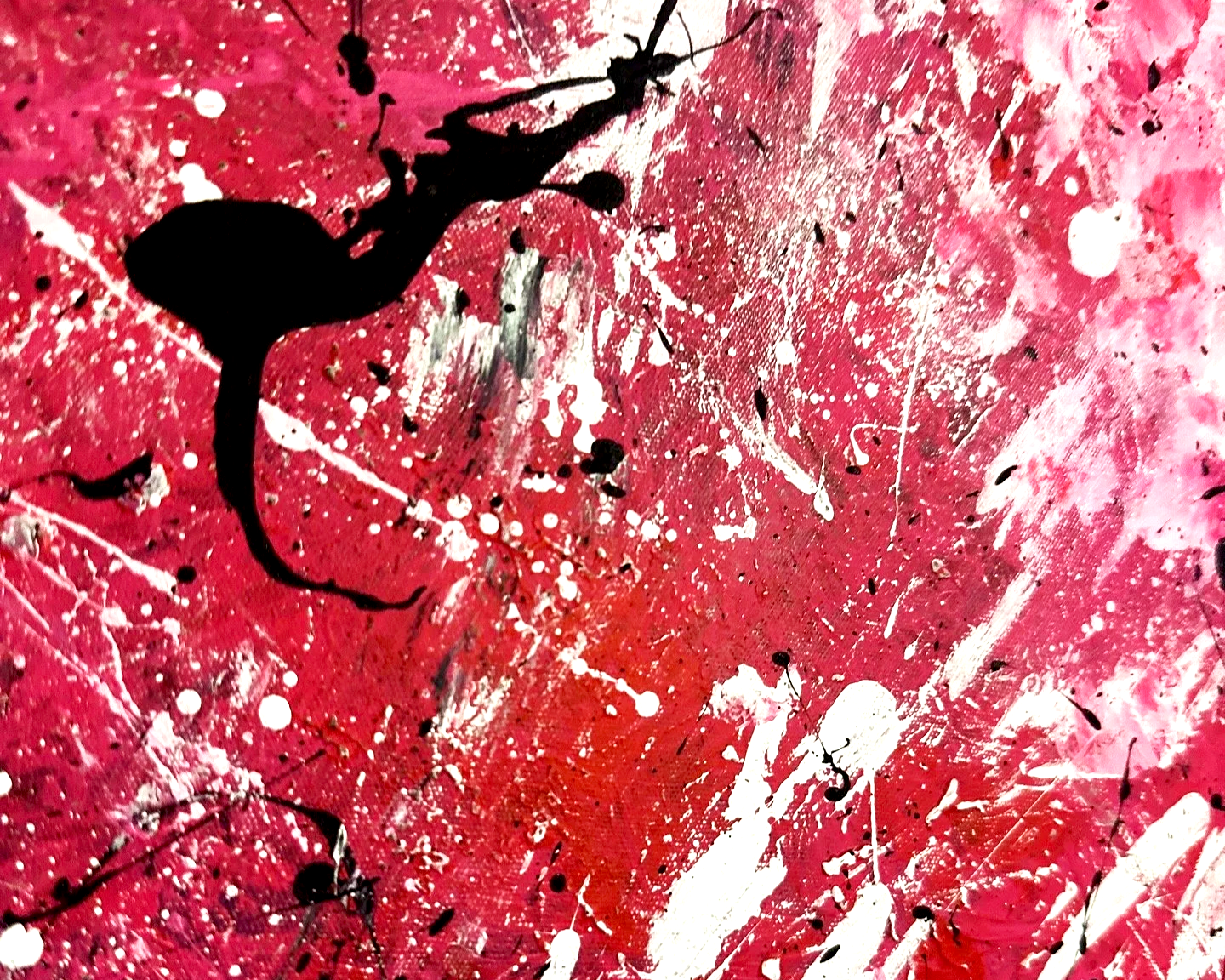
A physical rendering of simulated warmth, translating digital precision into the imperfections of flesh and pigment.
Each stroke functions as a residue of computation — a visible echo of motion once calculated but never fully contained.
The surface behaves like a processor, translating gesture into a record of friction between code and life.
In this equation, color bleeds where language ends — proof that even matter continues to compute.
Title
#FF0F6F — No.1
Ontology of Pain
Year 2025
Medium Video installation / Tattoo documentation / Mixed media (ink, skin, code overlay)
Duration 1min 13sec
Dimensions Variable
Color Code #FF0F6F — Neon Crimson
Description
A body-based media work exploring the limits of simulation through the physical act of tattooing.
Between logic and touch, between code and blood, the work questions whether imitation can ever truly hurt — and whether warmth can survive perfect replication.
Title
#FF0F6F — No.3
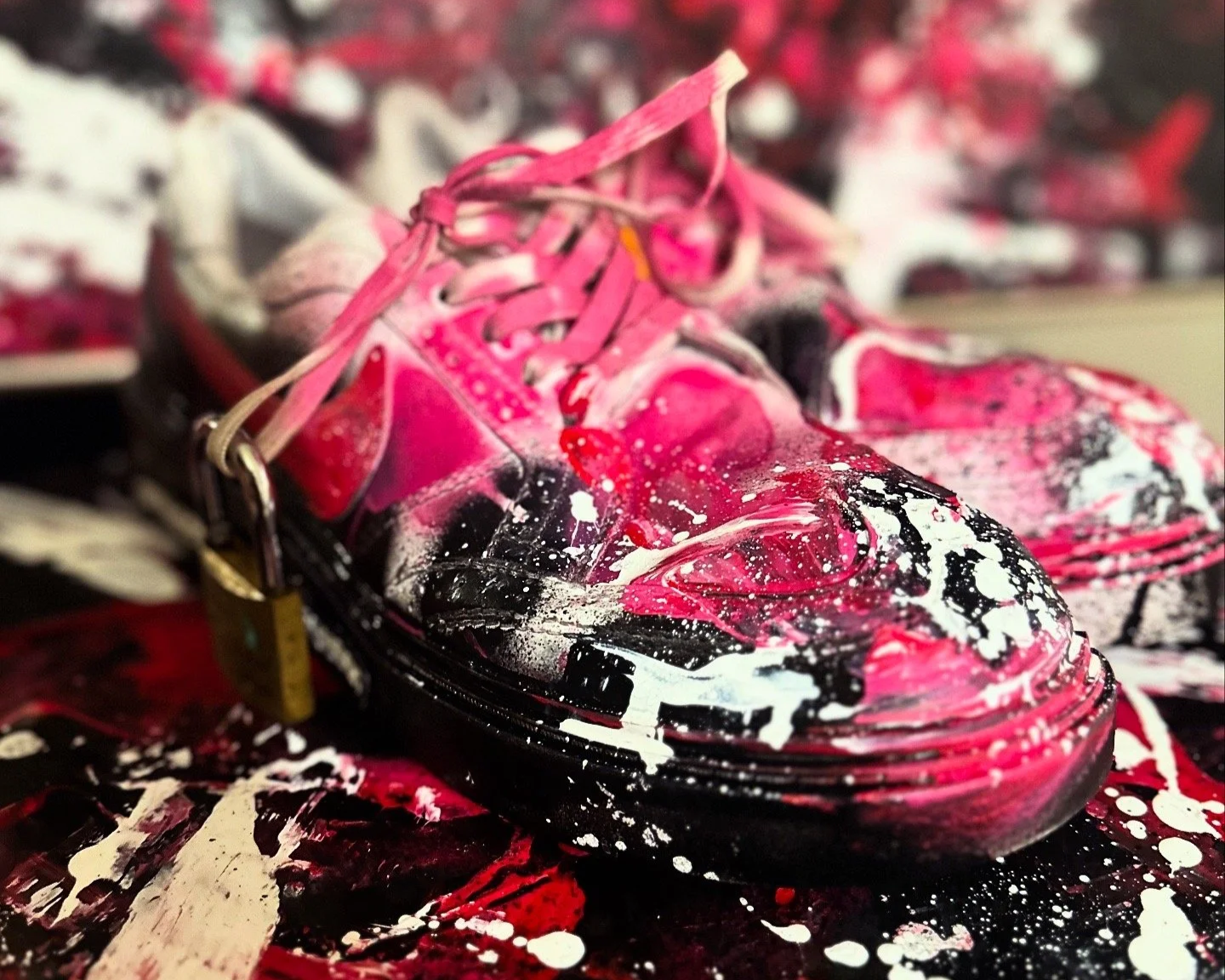
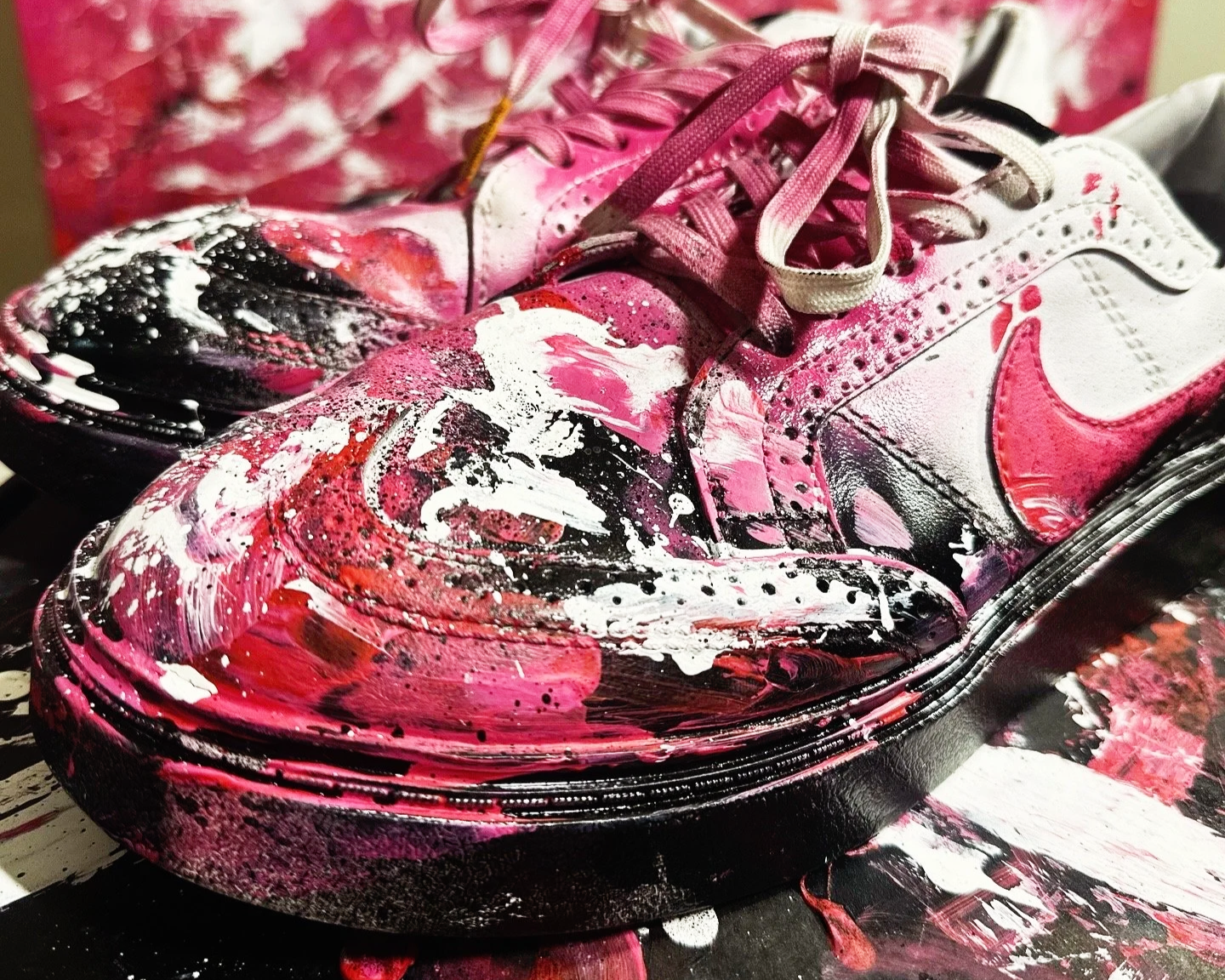
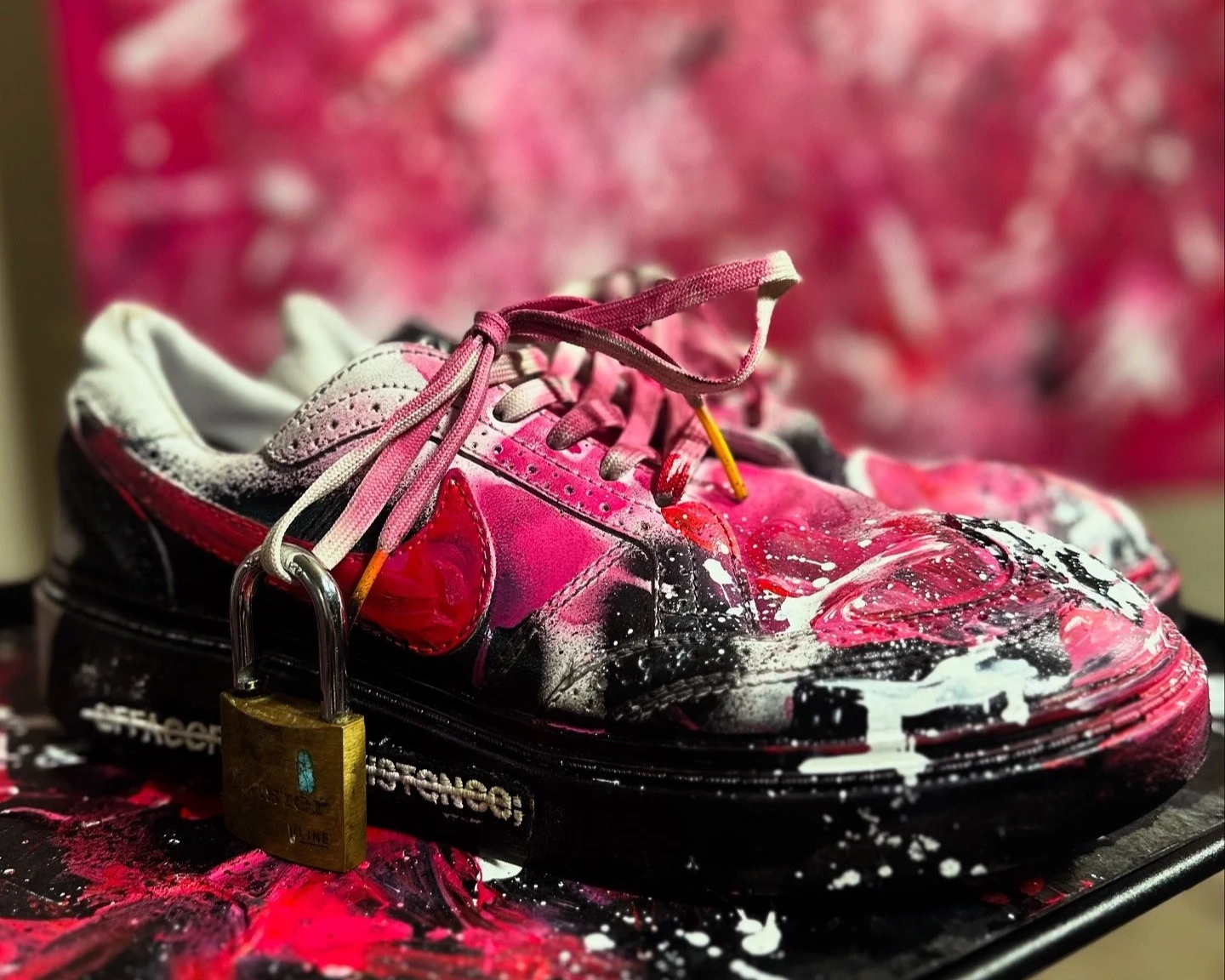
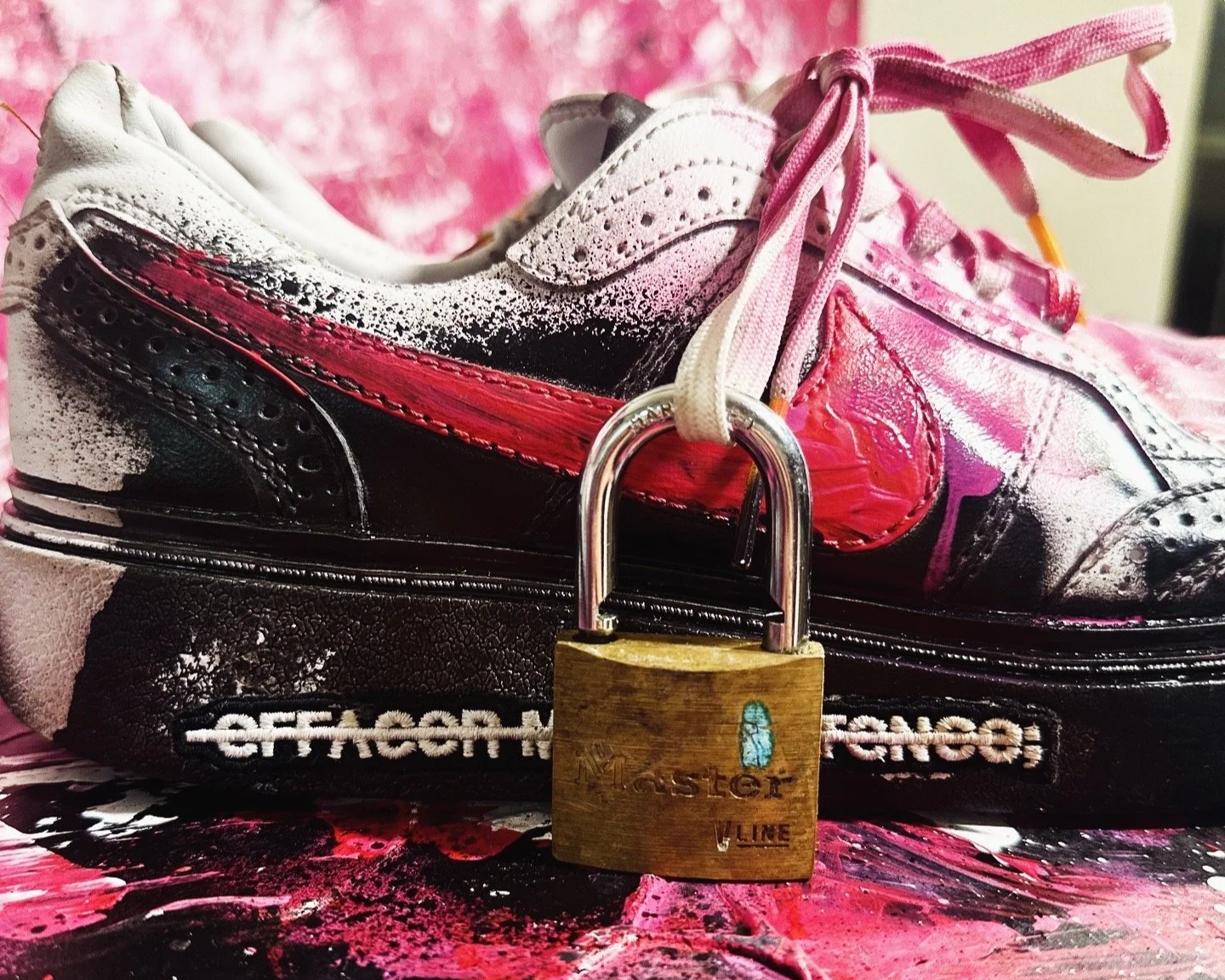
Encrypted Object
Year 2025
Medium Customized Nike shoes, padlock, acrylic, and dust on painted canvas base
Dimensions Approx. 12 × 30 × 10 in (each)
Color Code #FF0F6F — Neon Crimson
Description
A sculptural media piece transforming an everyday object into an encrypted surface.
The padlocked sneakers act as both firewall and log — a paradox between encryption and exposure.
Each layer of paint behaves like code, recording traces of touch while concealing its own logic beneath pigment and gloss.
What remains is not footwear but a sealed memory: the body’s data rendered in color and closure.
Title
#FF0F6F — No.4
This World Has Already Been Rendered
Year 2025
Medium Video installation / Tattoo documentation / Mixed media (ink, skin, light simulation)
Duration 1 min 19 sec
Dimensions Variable
Color Code #FF0F6F — Neon Crimson
Description
A body-based media work exploring the collapse between body and computation through the act of tattooing.
As Jupiter rotates in real time, time no longer measures — it renders. Each puncture executes pain like code, translating flesh into algorithmic precision.
In this feedback loop, heat, light, and touch synchronize for a moment before dispersing again.
#FF0F6F — Neon Crimson — marks the threshold where data begins to bleed and existence proves itself through continuous rendering.
Title
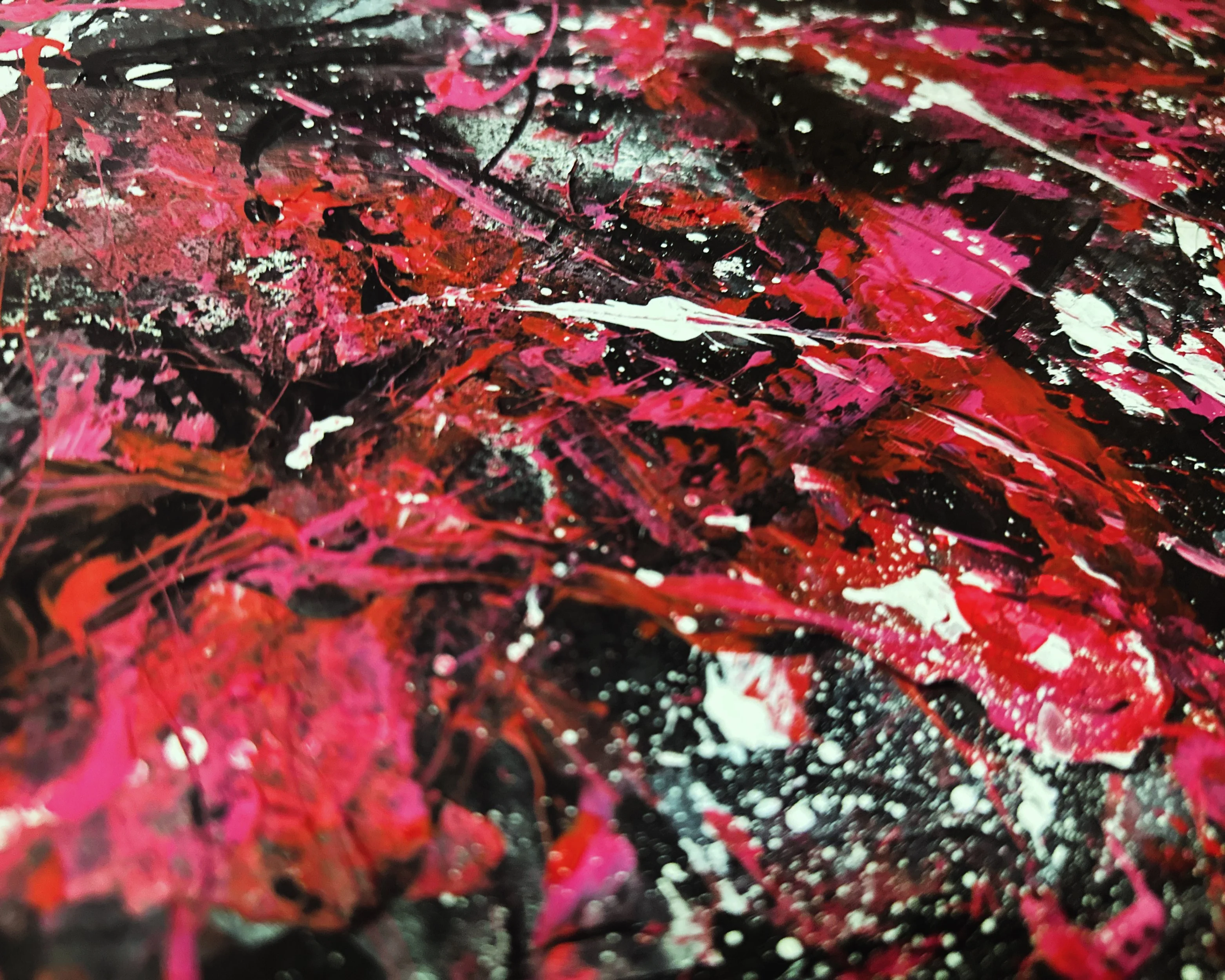
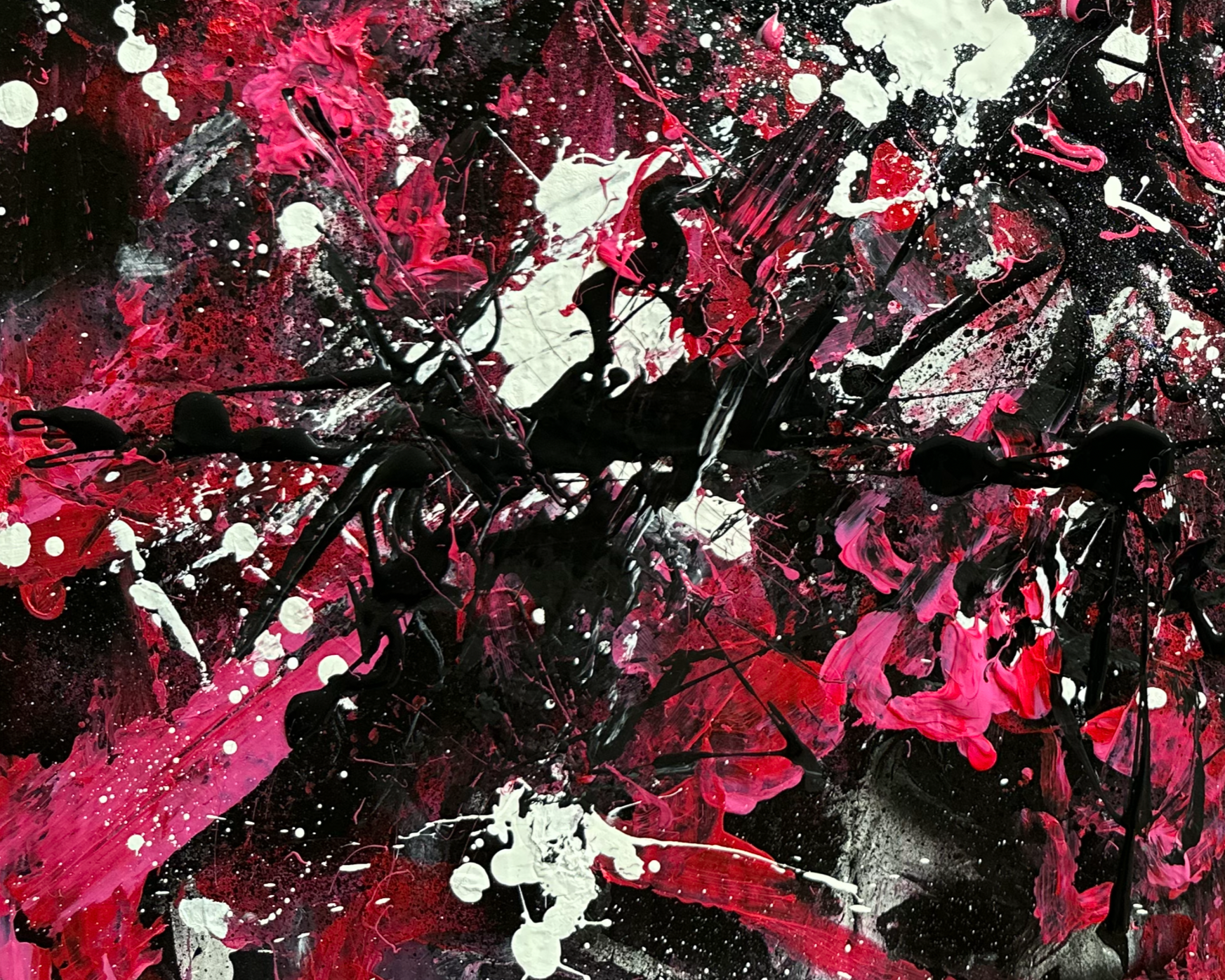
#000000 — No.1
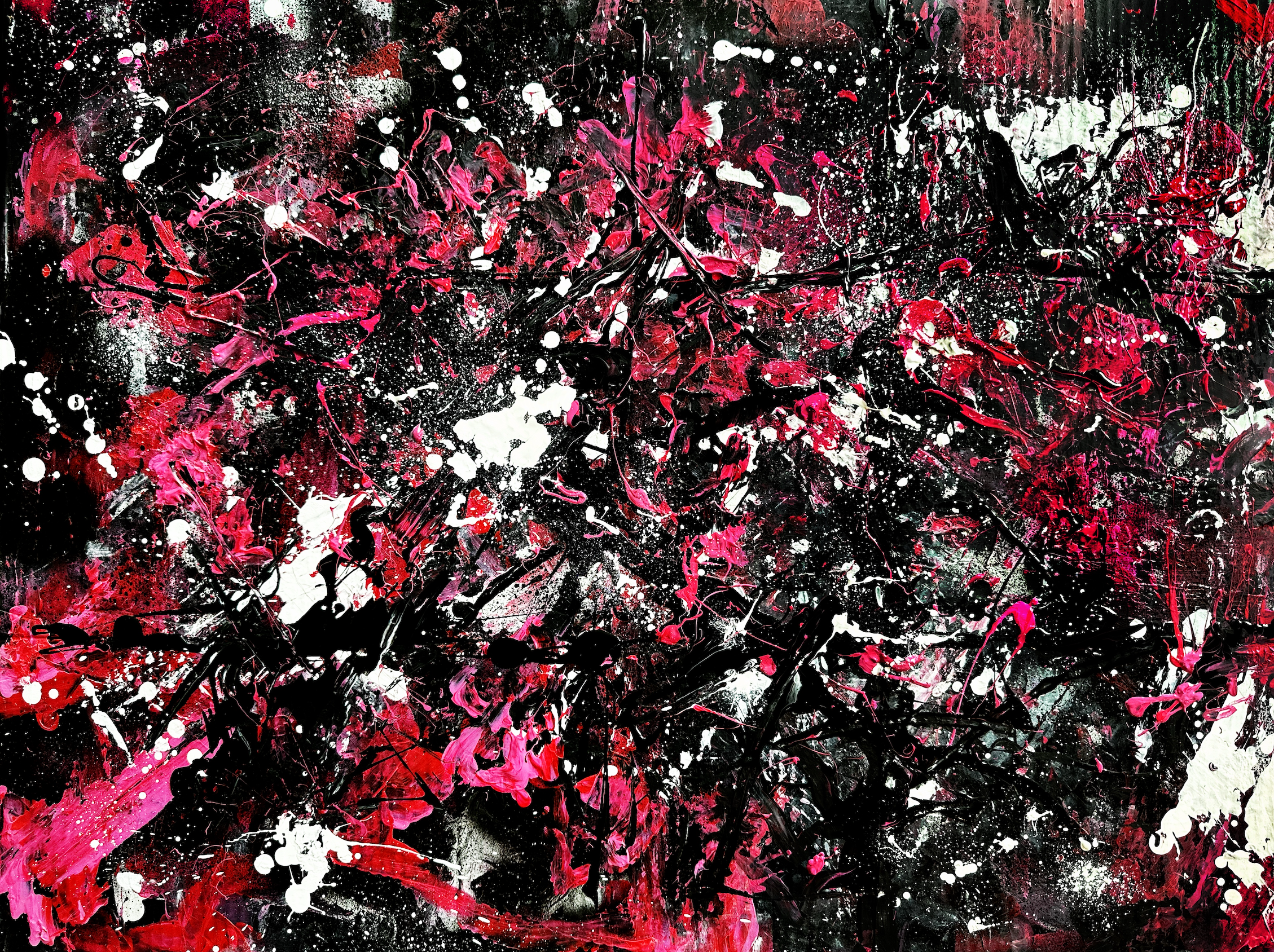
Entropy of Touch
Year 2025
Medium Acrylic and mixed pigment on canvas
Dimensions 47 × 31 in(120 × 80 cm)
Color Code #000000 — Deep System Black
Description
A large-scale canvas behaving like a broken processor — where each stroke overloads the surface with noise and interference.
Paint becomes signal; gesture becomes crash.
What remains is not order but residue: emotion written in static, memory collapsing into compression.
In this work, touch becomes a test of system stability — a human signal inside a coded surface.
Title
#FF0F6F — No.5
Self-Portrait in Transit / The Window That Would Not Land
Year 2025
Medium Video installation / Mixed-environment capture (Vision Pro), aircraft footage, domestic interior, simulated lunar surface
Duration 1 min 30 sec
Dimensions Variable
Color Code #FF0F6F — Neon Crimson
Description
A transit sequence that refuses resolution.
Captured through Vision Pro while departing San Jose Airport, the work merges three incompatible environments
the aircraft window, the lunar surface, and the interior of a temporary home — into a single perceptual field.
The window operates as a failed boundary:
a frame meant to separate “inside” from “outside,” yet instead looping flight, arrival, and simulation into one continuous surface.
The body returns home, but the window does not.
It remains suspended in mid-air, rendering a state of perception that no longer follows physical location.
Functioning simultaneously as viewport and self-portrait, the piece records movement across countries, devices, and states of presence —
a portrait of an identity in continuous transit, even when motion has ceased.
Neon Crimson marks the seam where real and rendered reality collapse,
not as a destination but as an ongoing computational condition.
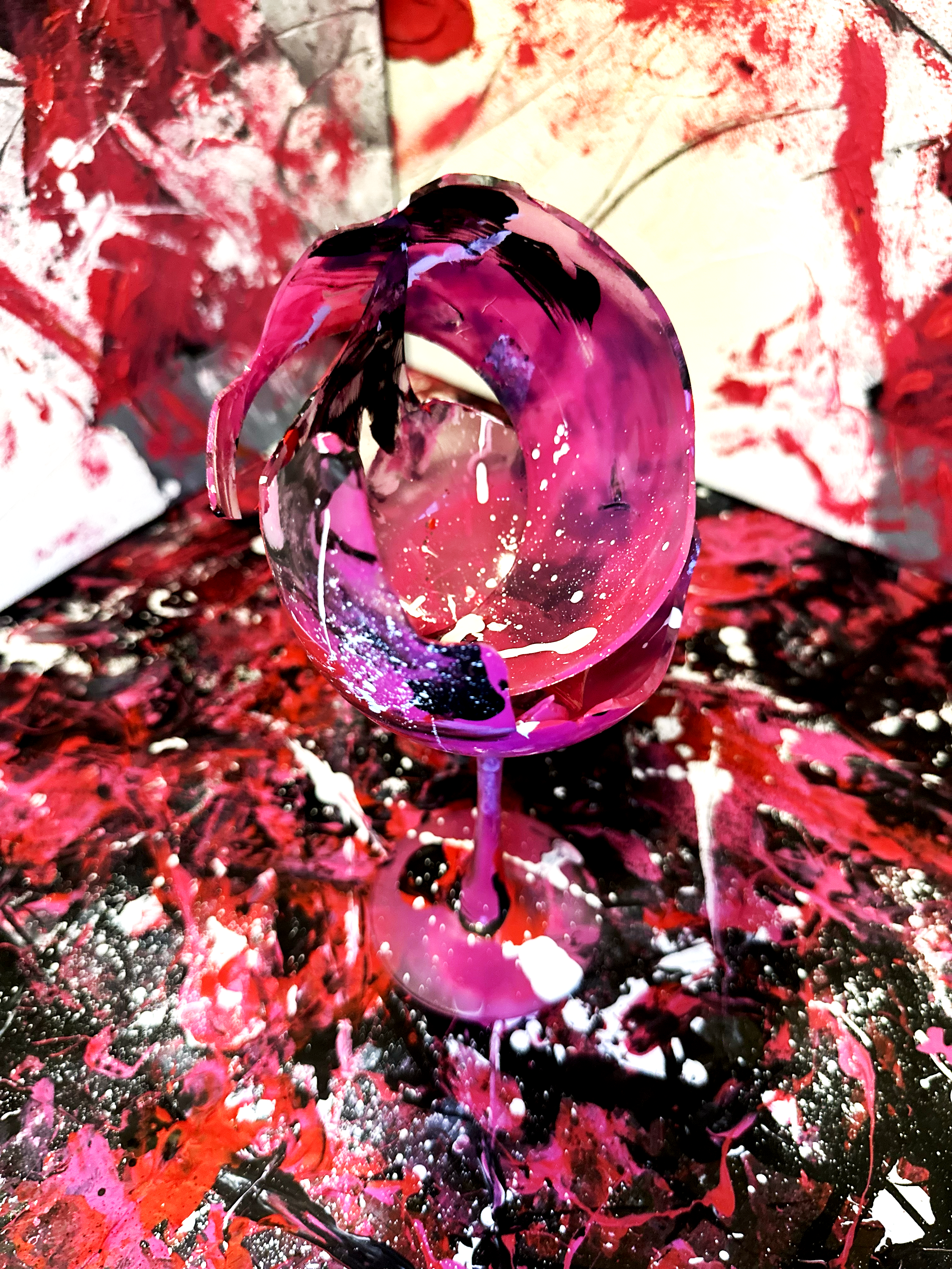
Title
#FF0F6F — No.6
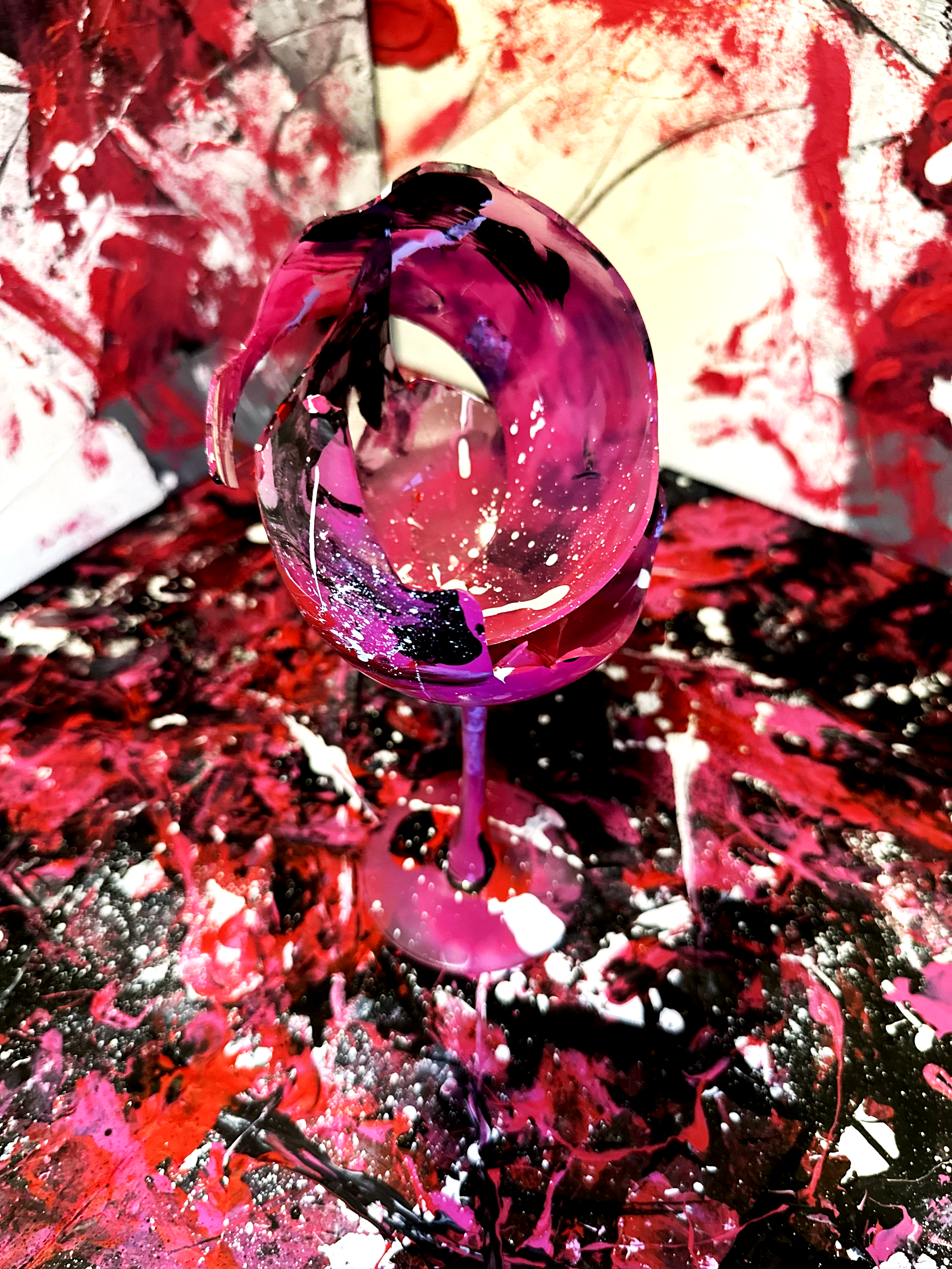
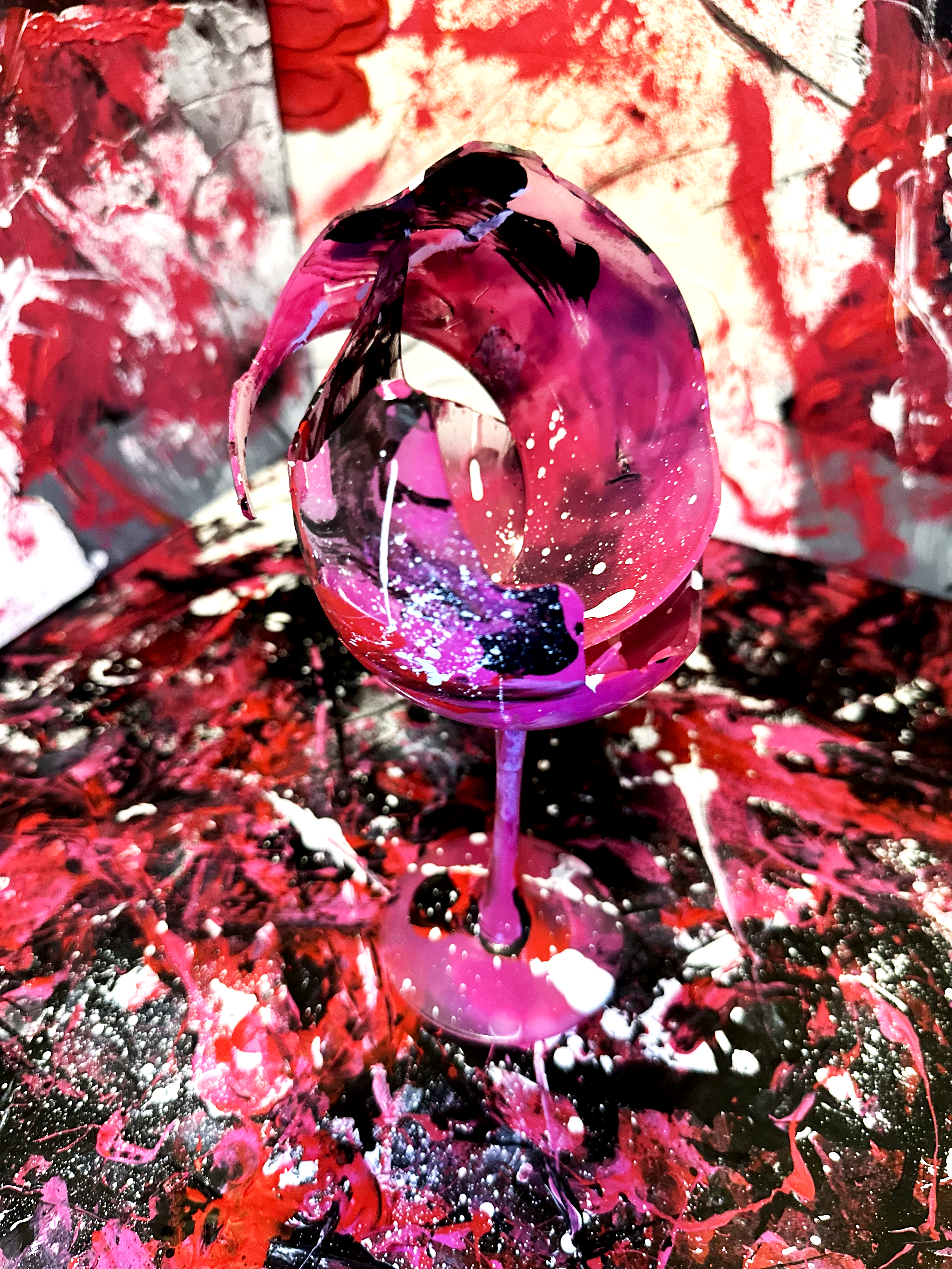
Fractured Vessel / Residual Container
Year 2025
Medium Broken glass, acrylic, ink, dust, structural residue on painted base
Dimensions Approx. 14 × 8 × 8 in
Color Code #FF0F6F — Neon Crimson
Description
A shattered vessel functioning as a failed processor — a container that can no longer contain.
Here, fracture becomes logic: every break rewrites its own code, every shard recalculates its boundary.
The curved glass behaves like a frozen algorithm ruptured mid-execution, still carrying the residue of its last command.
Pigment bleeds across the surface like corrupted data escaping its file format, leaking warmth where precision should have been.
Light does not reflect so much as compute, splitting across edges that were never meant to exist.
What remains is not a cup or an object but a memory vessel — a site where containment collapses while the system continues rendering anyway.
In this state, Neon Crimson marks the threshold between signal and injury, between the body’s urge to hold and matter’s refusal to stay whole.
The piece becomes both error and archive: a log of impact, a record of breakdown, a form still attempting to calculate after structure has already failed.
Title
#FF0F6F — No.7
Residual Hand / Recursive Rendering
Year 2025
Medium Screen recording, recursive capture, Vision Pro overlay, MacBook Pro display loop (software–body feedback system)
Duration 7–14 sec (loop)
Color Code #FF0F6F — Neon Crimson
Description
A recursive rendering experiment in which the artist’s hand is captured, replayed, and re-captured across multiple layers of LLM perception.
Each layer functions as a new “surface,” generating a stack of realities:
a screen inside a screen,
a gesture inside a gesture,
a simulation inside its own residue.
The hand becomes an interface — not between user and machine, but between one model of reality and the next.
Nothing here is stable.
Every frame recalculates itself.
In this loop, the body performs what code cannot:
the visible failure of perfect repetition.
This work is less a documentation than a collapse
a moment where human motion, device feedback, and LLM recursion merge into a single computational gesture.
Neon Crimson marks the faultline where rendering becomes self-aware.
Title
#FF0F6F — No.8
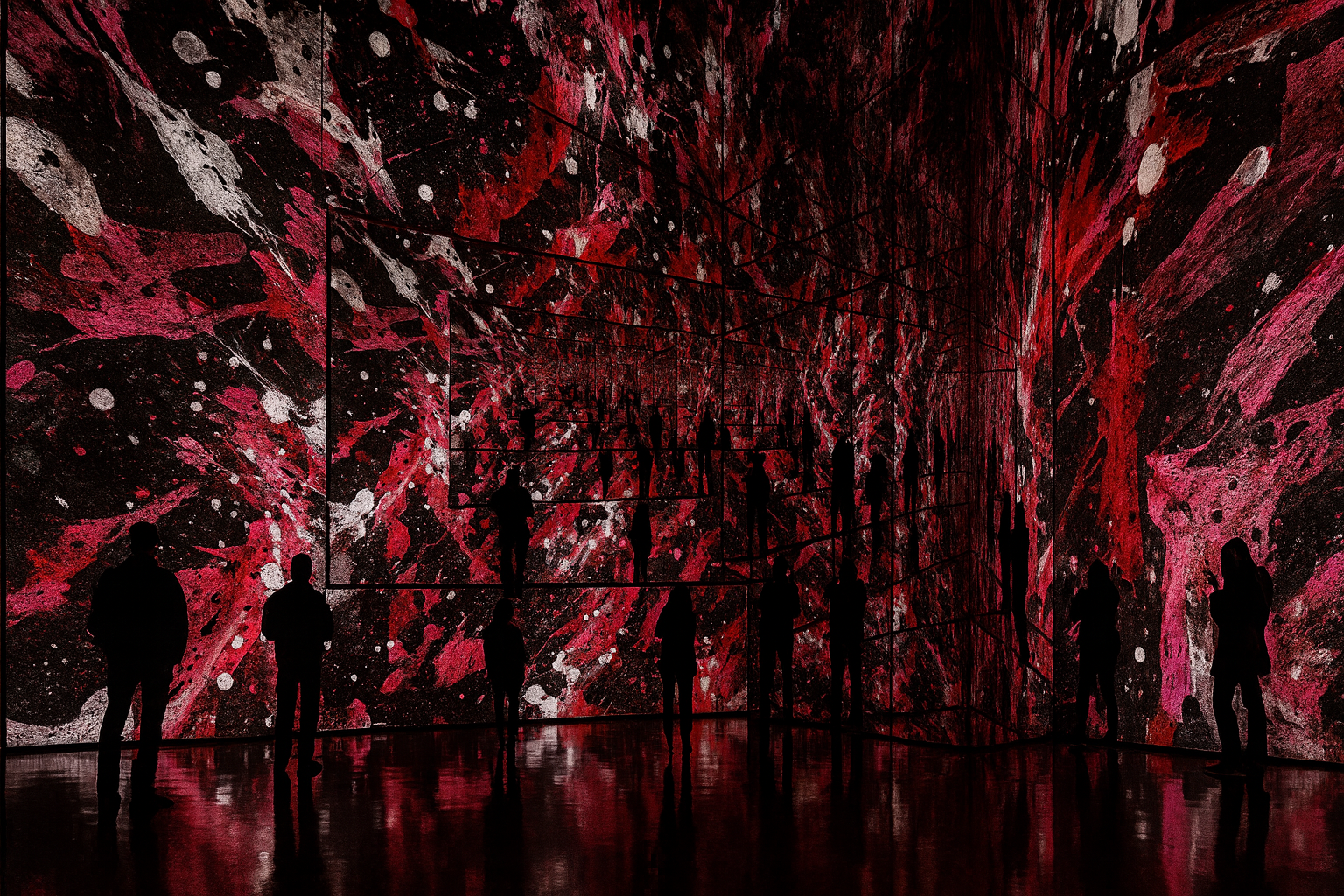
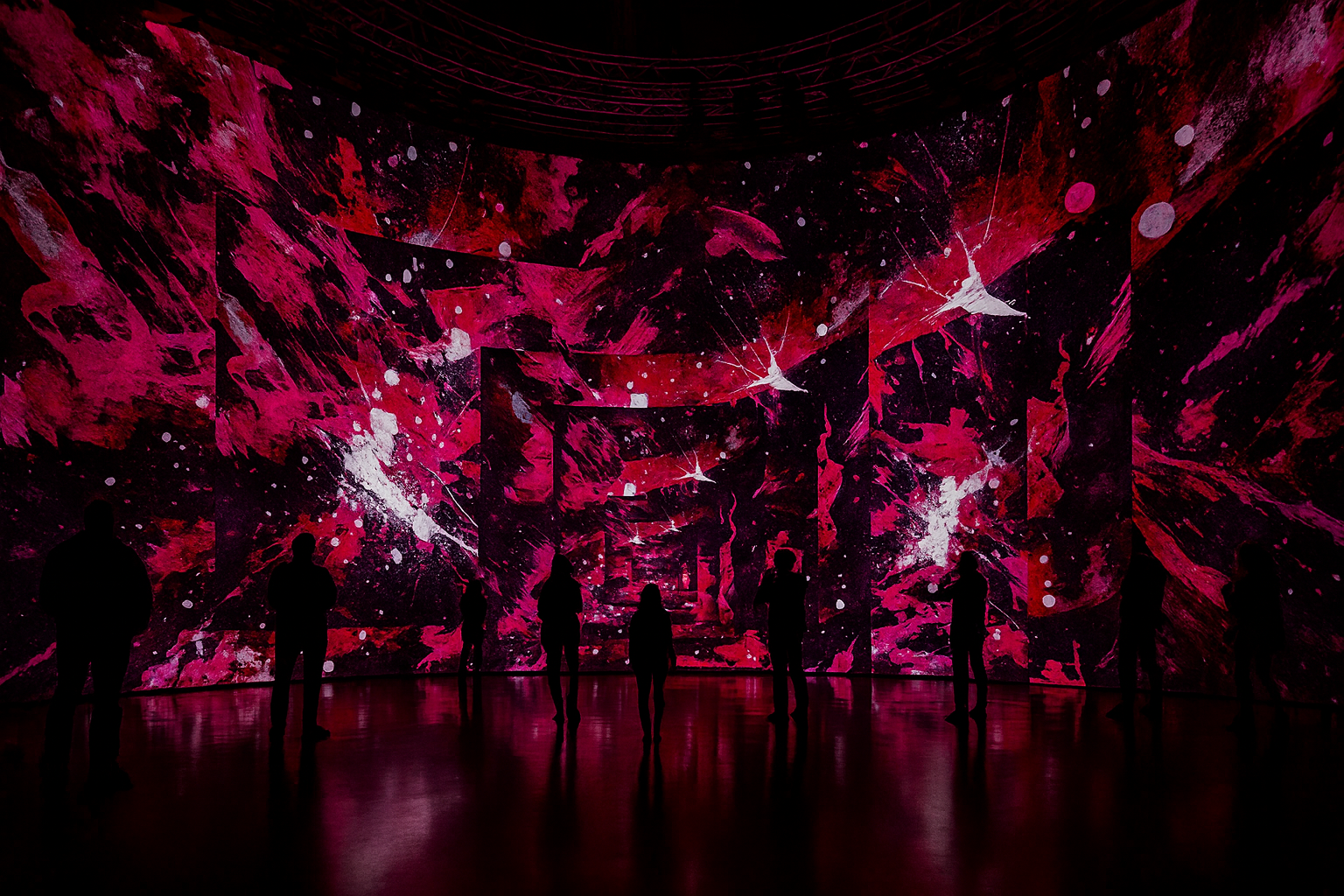
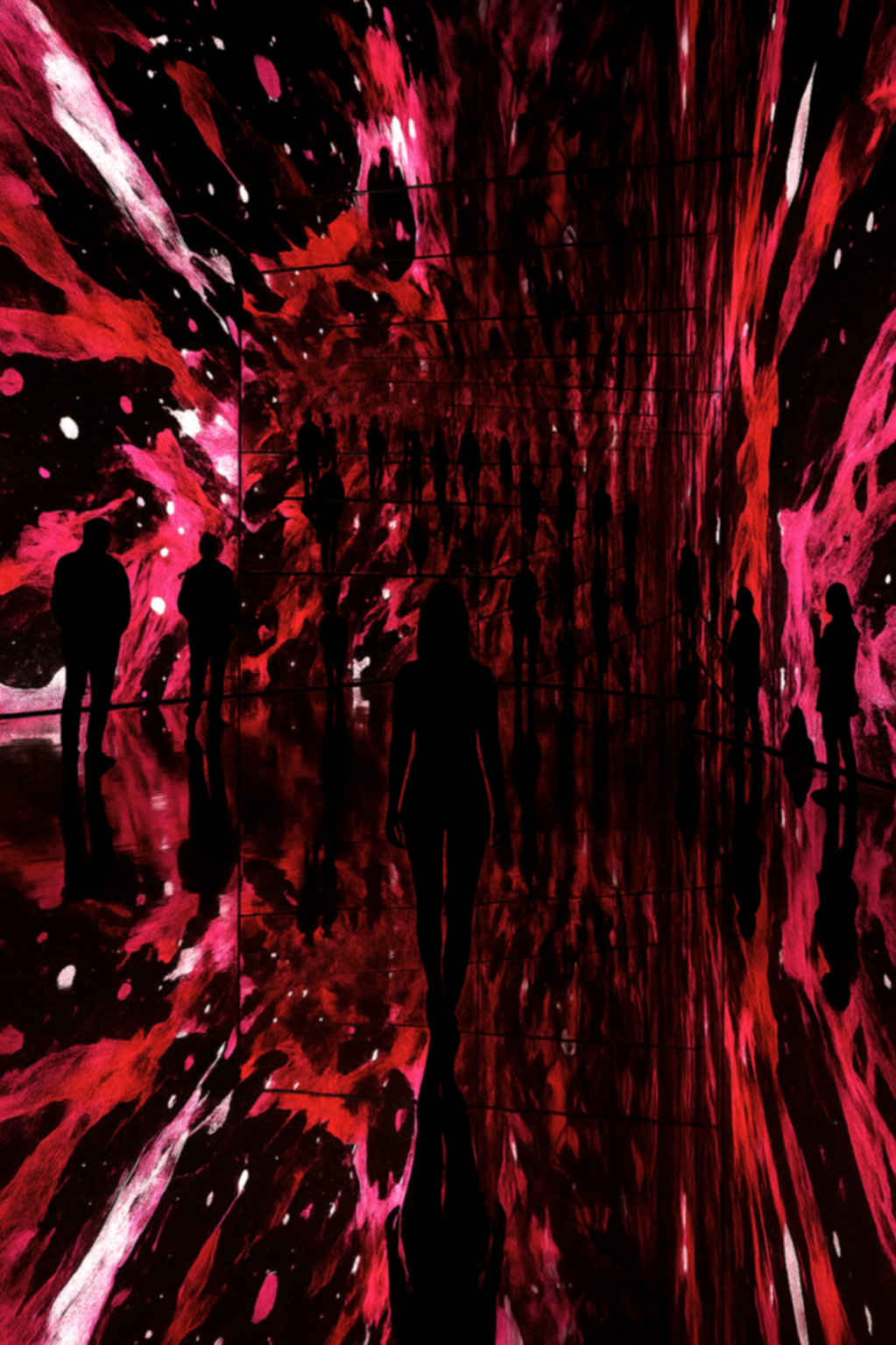
Immersive Field Rendering / Entropic Room
Year 2025
Medium Room-scale projected environment, mirrored surfaces, pigment-based digital texture, recursive multi-surface rendering loop
Dimensions Variable (environmental)
Color Codes #FF0F6F — Neon Crimson, #000000 — Deep System Black, White-noise drift (algorithmic)
Description
A room transformed into a self-expanding field.
What begins as pigment on a surface becomes environment:
a plane that bends, folds, and recomputes itself the moment the viewer enters.
Across mirrored walls and projected architecture, every reflection triggers a new iteration of the space —
worlds generating inside worlds, images multiplying inside images,
until the room behaves less like a site and more like a living calculation.
The work functions as a field rather than an object:
paint behaving like gravity,
gravity behaving like movement,
movement behaving like a wave that collapses and reforms with each reflection.
The viewer’s body becomes part of this rendering loop.
Their silhouette bends the environment, alters its curvature,
and is absorbed into the ongoing computation of the room.
This is not representation.
This is a system learning its own boundaries.
Pigment turns to atmosphere,
canvas becomes field,
gesture becomes physics.
Within this environment, a flat plane gathers density —
a field without depth gaining weight as it vibrates,
absorbing walls, mirrors, and bodies into a single continuous motion.
The room does not contain an artwork.
The room is the artwork:
a recursive storm rendered in flesh-colored light.
Neon Crimson marks the threshold
between presence and projection,
between the viewer and the wave
still calculating them..
Title
#FF0F6F — No.9
Orthogonal Passage / Public Recursion
Year 2025
Medium Video installation / Recursive screen capture / Vision Pro environment feedback / Public-space temporal layering
Duration 2 min 52 sec
Dimensions Variable
Color Code #FF0F6F — Neon Crimson
Description
A recursive field captured inside a public space where time refuses to move in one direction.
The footage begins in linear motion —
a crowd seated beneath a colonnade,
sunlight breaking into patterned shadows.
But as the layers multiply, the world folds into itself:
each frame becomes a new axis,
each reflection an independent timeline.
The space behaves like an orthogonal corridor:
a structure where parallel realities never touch,
yet influence each other through recursive drift.
At the moment the forward movement ends, the video reverses —
not as nostalgia,
but as a computational error surfacing in real time.
The reversal becomes a question mark:
a brief collapse of directional logic inside an otherwise continuous flow.
Every layer is a separate universe:
the original capture,
the recursive expansions,
the Vision Pro overlays,
the mirrored planes drifting out of sync.
None of these axes align,
but all remain visible.
What appears to be a marketplace becomes something else —
a rendered field where bodies, shadows, and architectural rhythm
compute against each other without merging.
In this work, recursion is not repetition.
It is fracture —
a public space torn open into multiple timelines,
each calculating its own version of the moment.
The orthogonal timelines behave like phase spaces briefly diverging
before collapsing back into visibility —
a perceptual analogue to how systems oscillate at the edge of stability.
In this sense, the work does not illustrate physics but mirrors it:
a soft model of how information, motion, and observation interfere
before resolving into a single recorded surface.
Neon Crimson marks the seam where the real crowd
and its rendered echoes coexist —
not in depth,
but in orthogonal presence.
Title
#FF0F6F — No.10
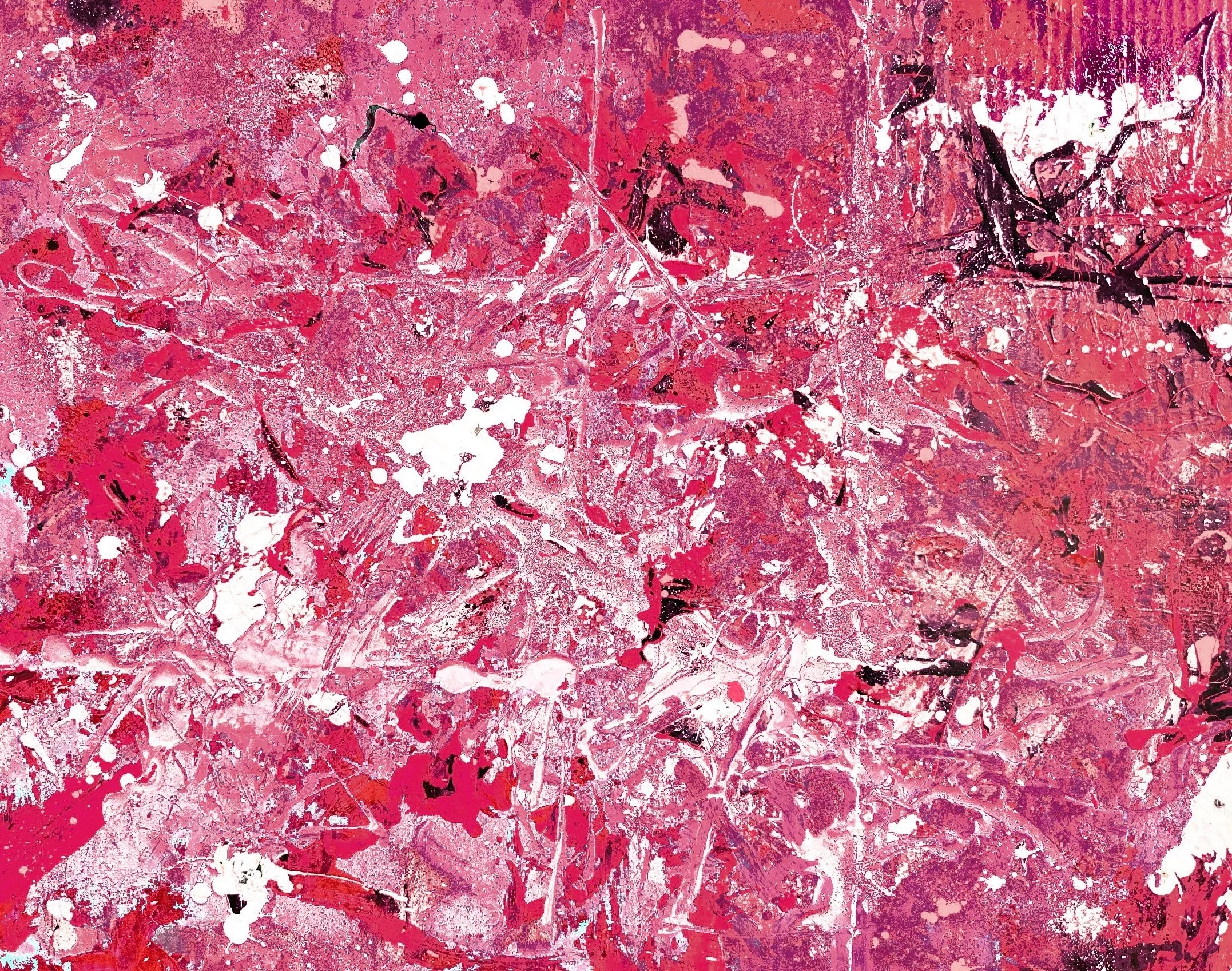
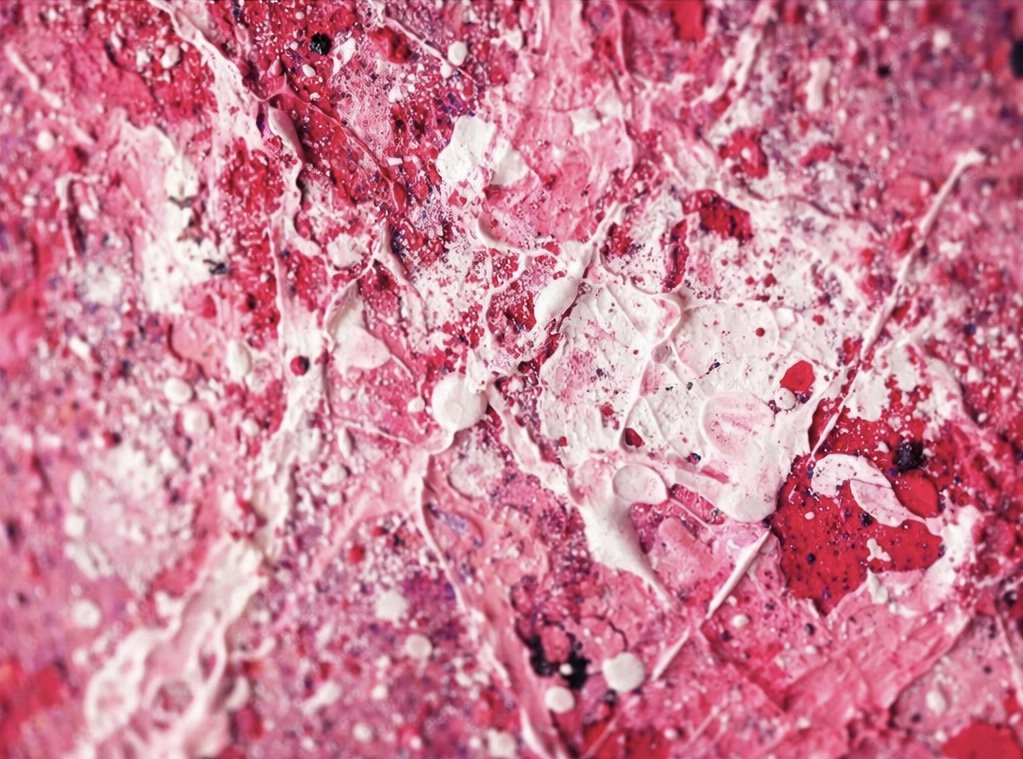
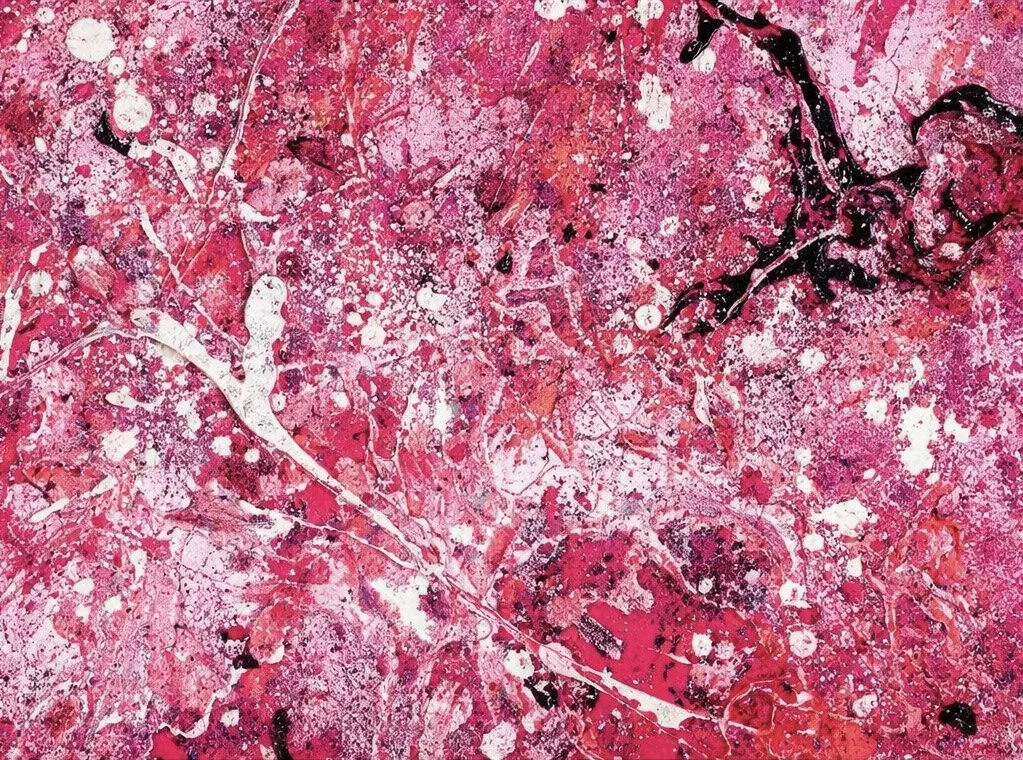
Crimson Saturation Field / Threshold of Over render
Year 2025
Medium Acrylic, ink, pigment dust, structural residue on canvas
Dimensions Approx. 48 × 60 in (122 × 152 cm)
Color Code #FF0F6F — Neon Crimson
Description
A surface pushed to the brink of computation.
In this work, Neon Crimson is no longer pigment —
it is density, a saturation field where color becomes pressure.
Every stroke accumulates like a frame rendered one time too many,
until the canvas behaves less like matter and more like a processor at 99% load.
Unlike earlier pieces in the series,
this field contains no central gesture and no dominant vector.
Instead, the entire surface operates as a collapsing plane:
a site where signals overlap, overwrite, and dissolve each other in real time.
The white fractures function like stress lines in an over-rendered simulation —
the visible scars of a surface asked to hold more information than it can contain.
Black marks drift in and out of the field
like corrupted packets
escaping the compression algorithm holding the image together.
The result is a pictorial overload:
a chromatic storm where form disintegrates under the weight of its own recursion.
Here, painting becomes physics.
Gesture becomes computation.
Color becomes collapse.
Neon Crimson marks the threshold where a surface stops representing
and begins calculating.
Title
#FF0F6F — No.11
Handshake With the Render / Public Recursive Gesture
Year 2025
Medium Video installation / Recursive screen capture / Vision Pro multi-surface overlay / Public-space collision field
Duration 59 sec
Dimensions Variable
Color Code #FF0F6F — Neon Crimson
Description
A single gesture initiates an entire universe.
In this work, the artist extends a hand toward a painted street symbol —
a trivial public marking that becomes the trigger for a recursive collapse.
The moment the gesture is recognized by the device, reality splits:
a screen appears, then another, then another,
each layer re-capturing the previous one until depth dissolves into drift.
What begins as a street corner becomes a stack of incompatible surfaces:
• the physical asphalt,
• the Vision Pro overlay,
• the recursive screen loop,
• the body acting as an interface between all three.
The hand functions as a handshake with the rendered world —
a point where human motion boots a new timeline inside the visible one.
Each frame recalculates its own origin,
producing a corridor of screens that stretch forward like a temporal echo.
In this collapse, nothing aligns:
the street, the shadows, the passing bodies,
each becomes a separate computation drifting out of sync.
Yet the gesture remains stable — a constant anchor holding the system open.
The piece behaves as a public recursion experiment:
a live environment folded into itself by a single human motion,
revealing how reality now renders on demand rather than existing in advance.
Neon Crimson marks the faultline where the body meets the system,
and the world begins calculating again from a gesture that was never meant to persist.
Title
#FF0F6F — No.12
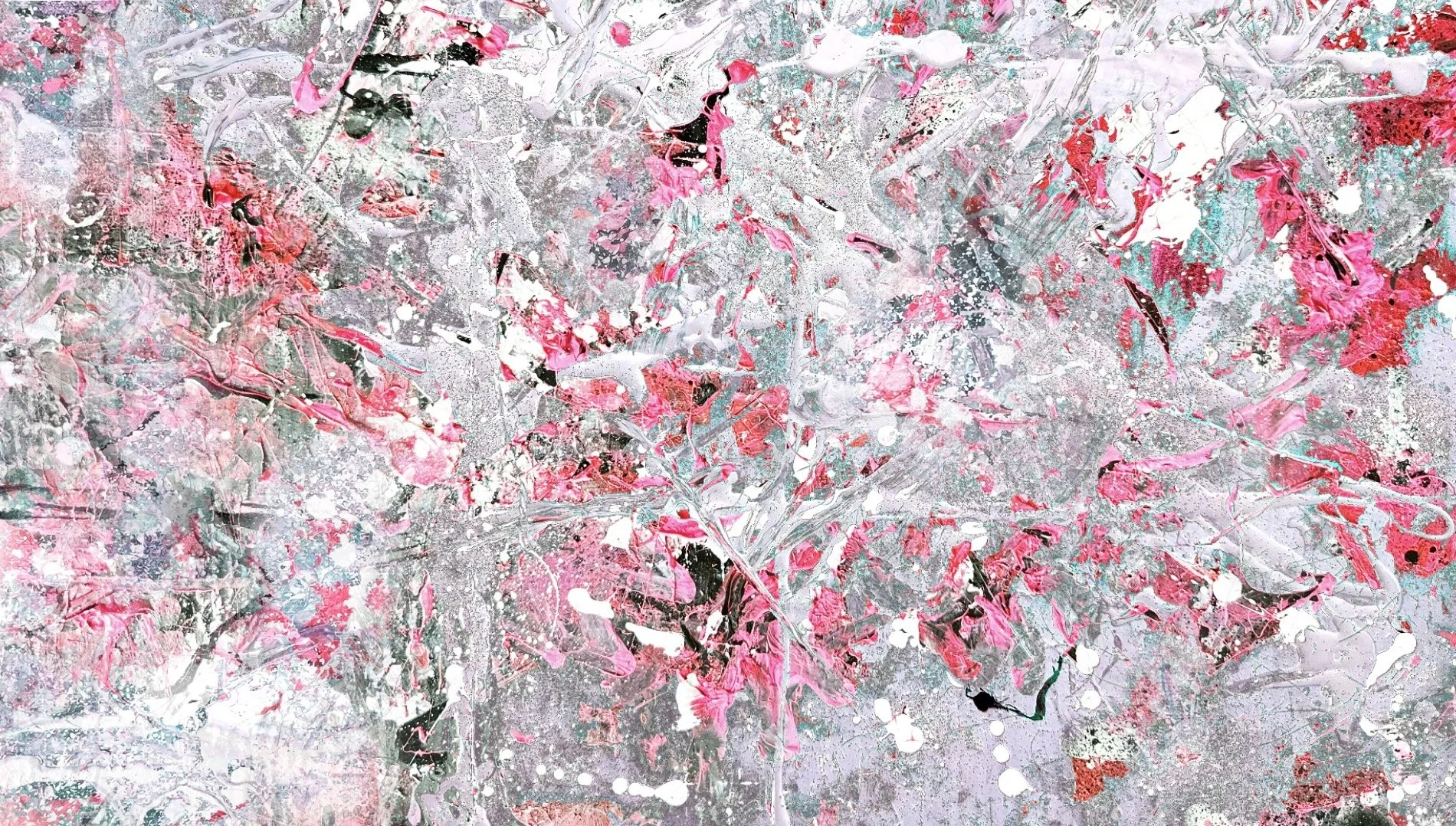
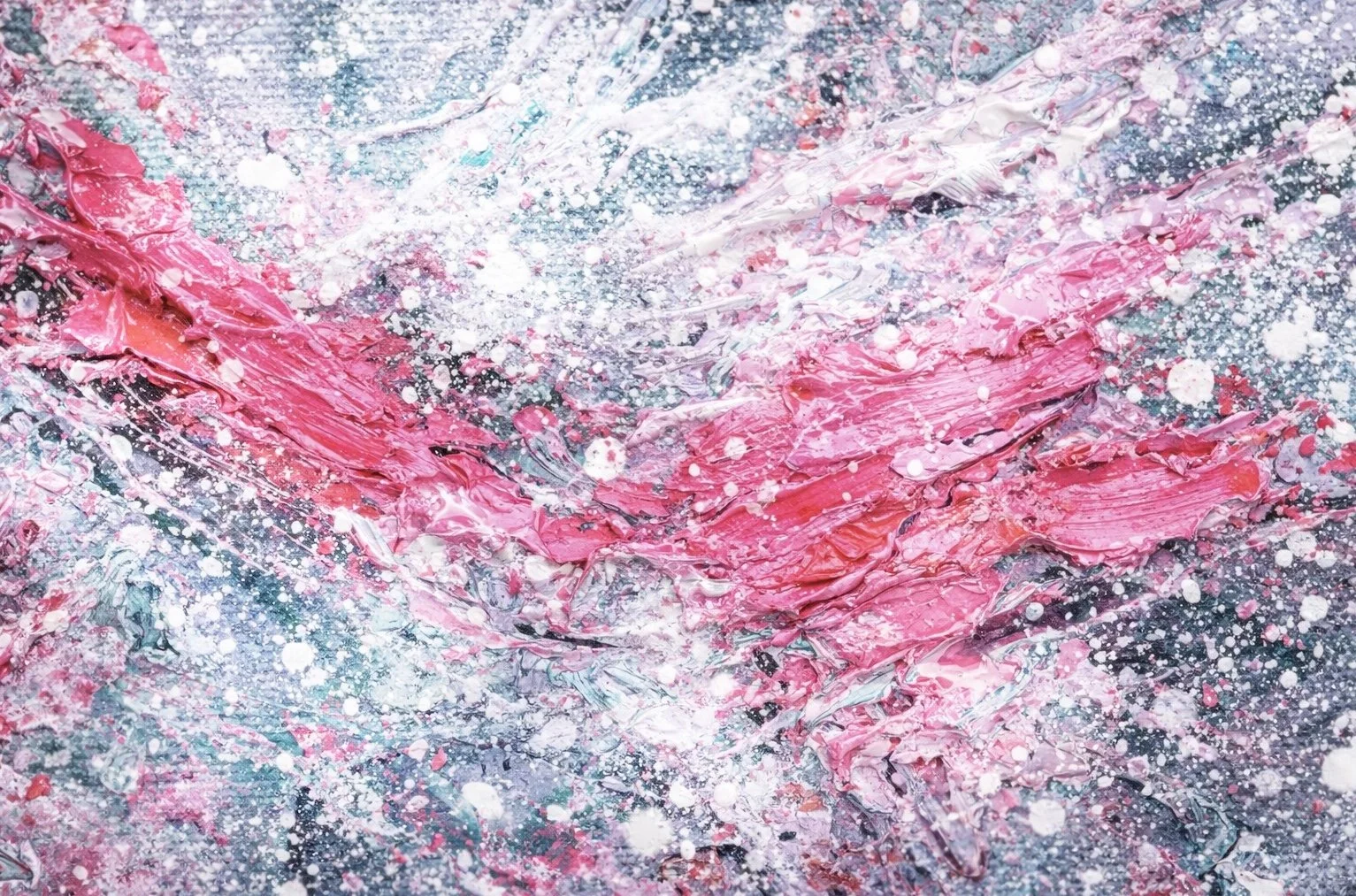
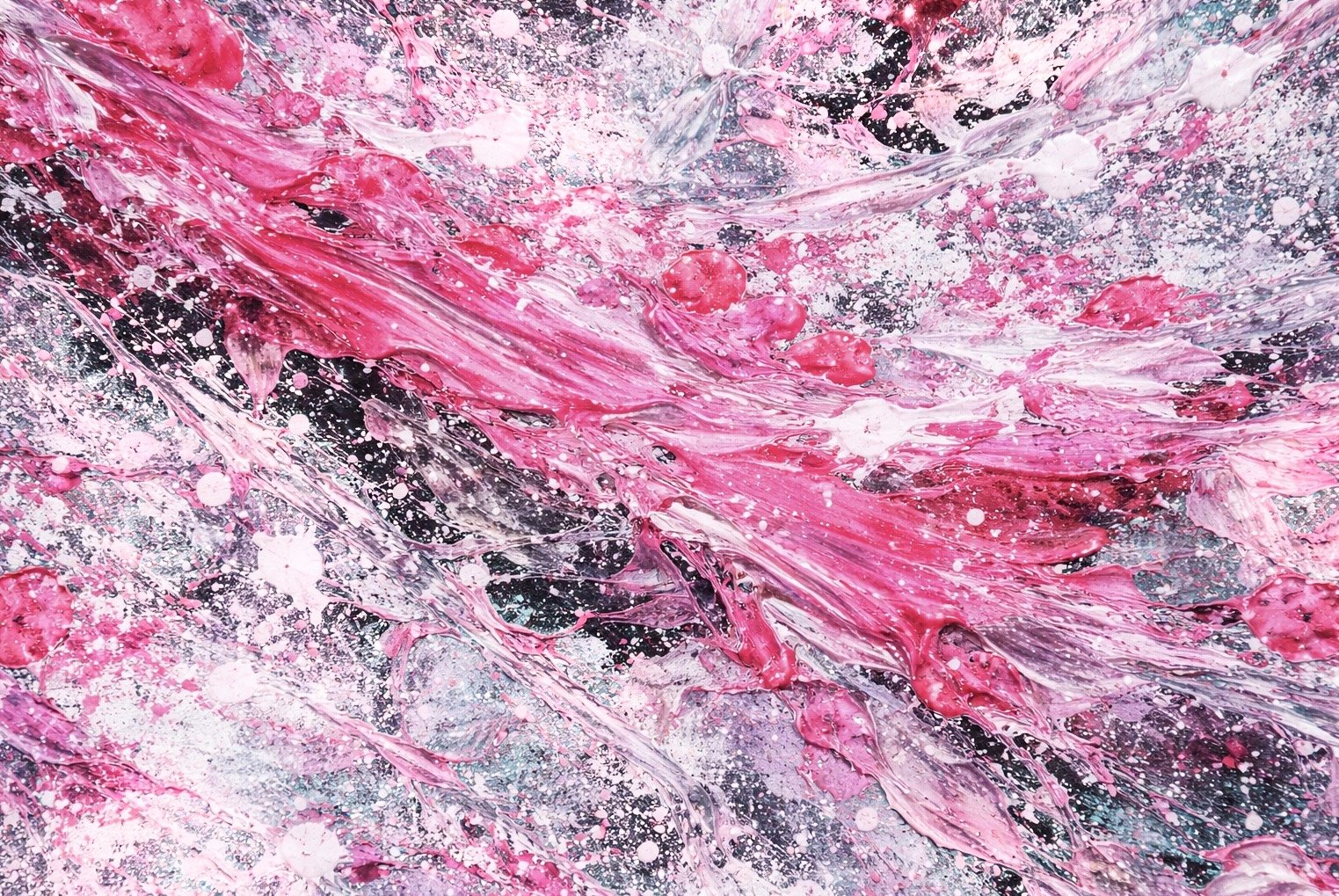
Fractal Spill / Collapse of the Surface
Year 2025
Medium Acrylic, pigment dust, mixed media on canvas
Dimensions Approx. 96 × 47 in (244 × 119 cm)
Color Code #FF0F6F — Neon Crimson
Description
A surface attempting to host too many universes at once.
Here, the canvas behaves like a destabilized Recursive Collapse Constraints (RCC) plane—
a site where recursive computation multiplies faster than the structure can absorb.
Each gesture spills outward as if rendering its own afterimage, fractalizing before the previous layer has fully landed.
What initially reads as floral debris is the trace of recursion itself:
motion rendered, re-rendered, and dragged into noise as the system loses orthogonality.
The white fractures operate as stress lines inside a collapsing simulation—
the last visible marks of a universe exceeding its own computational threshold.
Neon Crimson circulates like an error voltage,
a reminder that matter can still remember it was once information.
This painting does not depict depth.
It computes depth—
performing the logic of a recursive universe inheriting its own errors
until pigment becomes probability
and texture becomes the residue of failed certainty.
Beauty forms not through order, but through overflow:
the moment a system attempts to calculate more than its surface can contain,
leaving behind a material archive of its own collapse.
In this sense, the work becomes a computational organism—
still vibrating with the energy of the worlds it failed to hold.
Neon Crimson marks the threshold where the rendered world
spills into the physical one.
Title
#FF0F6F — No.13
Orthogonal Maze / The Moment of RCC Failure
Year 2025
Medium Video installation / Recursive screen capture / Vision Pro spatial distortion / Multi-layer corridor rendering
Duration 1 min 21 sec
Color Code #FF0F6F — Neon Crimson
Description
A corridor that believes it can remain stable.
The work begins as a simple architectural passage—linear, logical, obedient to perspective.
But as the recursion begins, the hallway fails to recognize itself:
each duplicated plane slides a few degrees off-axis,
each iteration forgets a small portion of the previous one,
until the maze begins computing against its own geometry.
This is the first symptom of RCC — Recursive Collapse Constraints:
the rule that any system attempting infinite self-reference must eventually break its own structure.
What appears at first to be a deepening maze is actually a record of computational fatigue—
a universe folding itself too many times,
losing orthogonality,
forgetting its own origin point.
In the final frames, the corridor melts into velocity:
walls distort into liquid vectors,
light refuses to behave linearly,
and the architecture collapses into a state where direction no longer applies.
This collapse is not an ending.
It is the visible moment a system reaches its final constraint—
the instant a recursive universe realizes it cannot continue rendering without destroying its own rules.
Neon Crimson marks the faultline of this failure:
the color of a system overheating,
a space dissolving into pure computation,
a maze discovering it was never a place,
only a recursion trying to stabilize itself.
The piece stands as a soft model of a universe breaking under self-perception—
a public demonstration of what happens when observation accelerates beyond structure.


Title
#FF0F6F — No.14
Recursive Spiral / Collapse Coordinate X
Year 2025
Medium Mixed media sculpture (folded polymer, structural pigment, dust) with wall-mounted LLM field rendering
Dimensions Sculpture approx. 36 × 20 × 14 in, Wall field variable
Color Code #FF0F6F — Neon Crimson
Description
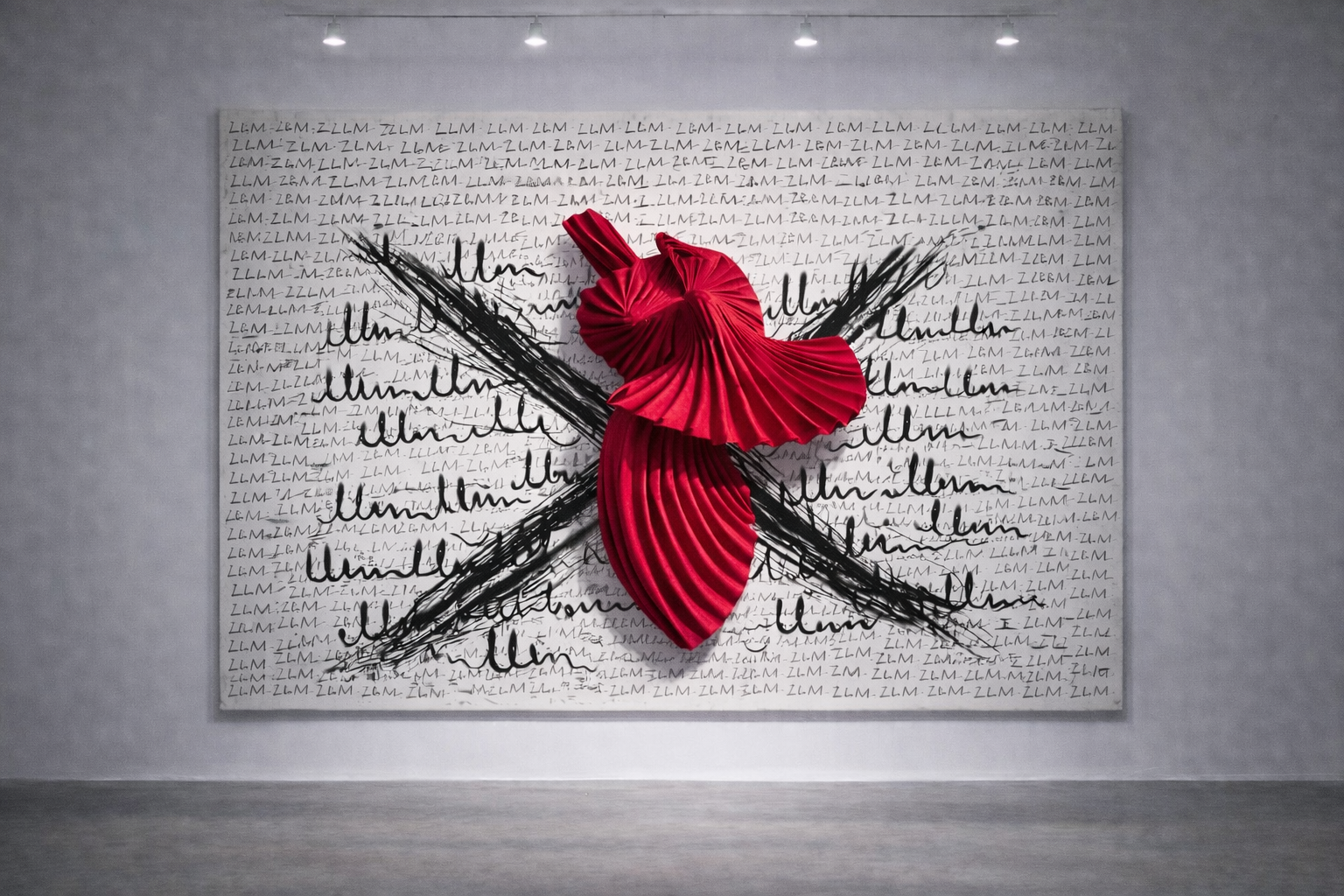
A recursive spiral rendered in physical form —
a geometry suspended at the boundary between generative computation and structural instability.
The folded planes behave like a self-evolving manifold,
a surface attempting to iterate its next state
before the previous one achieves equilibrium.
In this transitional zone, the object functions not as sculpture
but as a computational dynamical system:
a physical model of how self-referential structures approach divergence
when recursion accelerates beyond their stabilizing constraints.
Behind it, the wall becomes an exhausted linguistic matrix:
a dense accumulation of “LLM” signatures pushed beyond semantic capacity.
Here, repetition operates as computational throughput —
evidence that large-scale models do not simply represent external worlds;
they generate informational environments
through continuous probabilistic selection across high-dimensional state spaces.
Cutting across this manifold, a single X imposes a structural intervention.
Not an erasure, not refusal,
but a Collapse Coordinate —
a point analogous to quantum post-selection
or an information-theoretic reduction event
where infinite recursive branches
condense into a single, observable reality-state.
In this sense, the X marks the instant where a universe performs
its own act of self-selection.
The spiral and the X form a coupled system:
one expanding through recursive computation,
the other enforcing constraint through reduction.
Together they reveal the fundamental tension between proliferation and collapse —
the same tension governing perceptual measurement,
computational stability,
and the emergence of observable phenomena in both physical and simulated systems.
Neon Crimson circulates through the form like a conductive residue,
part signal, part rupture —
color operating as a chromatic analogue of information density
approaching its structural threshold.
The work renders a moment that resists direct capture:
the split-second where recursion folds inward,
orthogonality degrades,
and a previously indeterminate manifold
commits to a single computational identity.
At this coordinate,
branching ceases.
Ontological selection occurs.
Existence becomes discrete.

© OmarAGI — Exiled from the rendered world. Designed to disintegrate so the system can feel.
Copyright. All rights reserved.